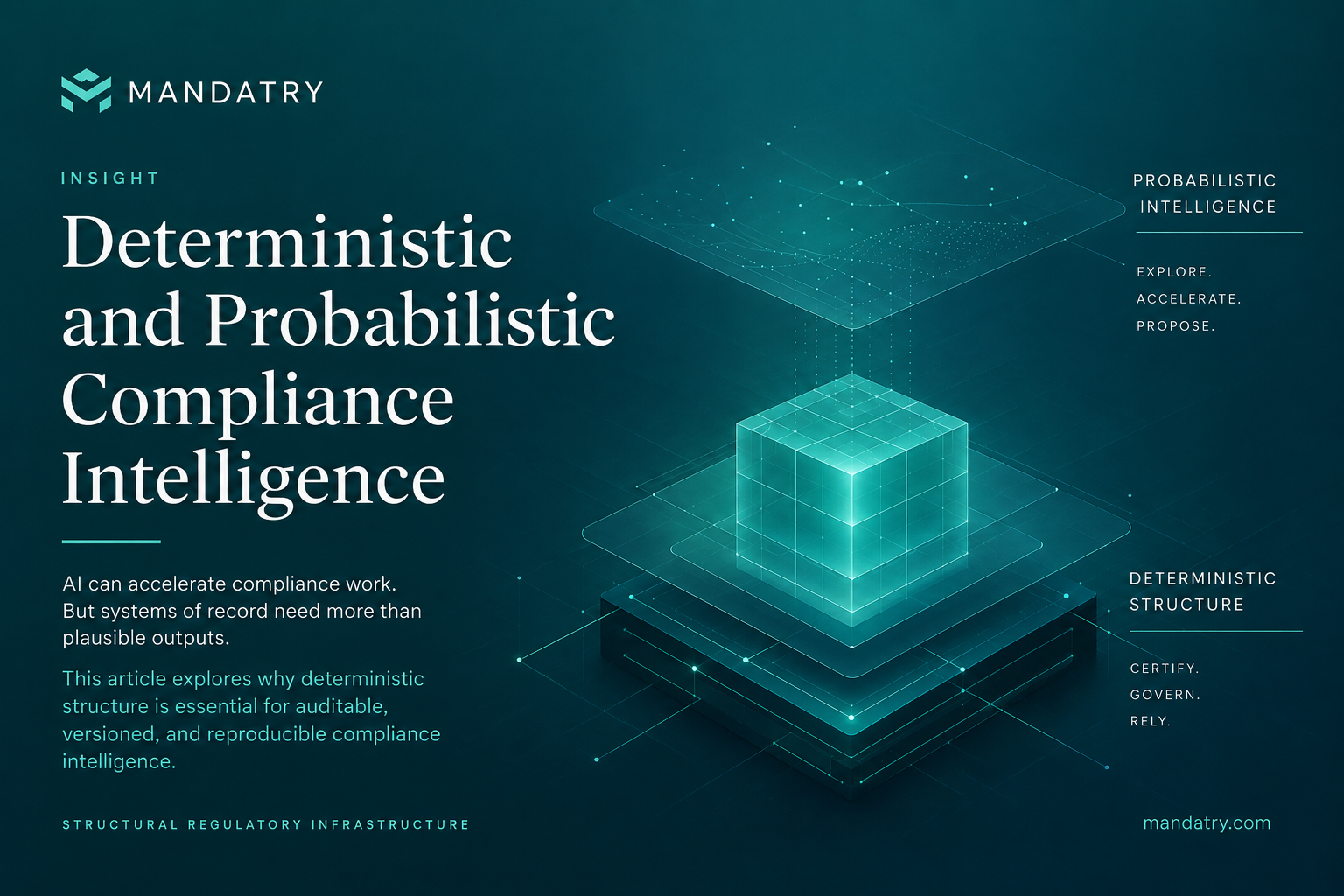
Deterministic and Probabilistic Compliance Intelligence
AI can accelerate compliance work through summarisation, extraction, and mapping suggestions. But systems of record need more than plausible outputs. They need deterministic structure that is stable, auditable, versioned, and reproducible across runs.
Most enterprises already have tools.
They have GRC platforms, monitoring tools, control libraries, spreadsheets, and advisory support.
What they usually do not have is a stable structural layer beneath those systems.
As AI becomes more capable, it is easy to treat all compliance intelligence as one category. It is not.
There is a meaningful difference between probabilistic intelligence, which helps teams move faster, and deterministic structure, which allows organisations to govern, audit, and rely on the result.
That distinction matters most when the output is no longer just advisory, but part of a system of record used across audits, frameworks, and jurisdictions.
Two kinds of intelligence
Probabilistic intelligence is useful because it can produce plausible outputs from messy input.
It can detect patterns, rank candidates, surface likely relationships, and accelerate work that would otherwise take much longer to do manually.
That is valuable.
What it cannot guarantee is that the same input will always produce the same approved result in the same governed way.
Deterministic structure serves a different role. Its purpose is to produce stable outputs. Those outputs can be versioned, audited, and reproduced. They can support integration across systems because they behave as governed infrastructure rather than as a best-effort interpretive layer.
That is the core distinction. One helps you explore, accelerate, and propose.
The other helps you certify, govern, and rely on the result.
Why AI matters but is not enough
Compliance inputs are messy.
Regulations arrive as long-form prose.
Guidance evolves.
Frameworks overlap imperfectly.
Language changes by jurisdiction, drafting style, and regulatory context.
This is exactly where AI is useful.
It can help with
→ accelerating ingestion of source material
→ extracting candidate obligations from text
→ proposing likely canonical mappings
→ detecting possible changes or anomalies across versions
→ reducing the amount of first-pass manual work
That is meaningful operational leverage. Infrastructure, however, requires a stronger guarantee than usefulness.
It requires stability. Even a system that generates strong candidates can still be unsuitable as the final authority for certified regulatory structure.
A simple example
Imagine a team ingesting three related sources. One regulation expresses a requirement in one way.
A standard expresses a similar expectation through control language.
A sector-specific rule adds more specific operational language.
A probabilistic system may correctly suggest that all three point towards a related security concept.
Problems begin when the output shifts across runs, across model versions, or across prompt conditions.
At that point, the question is no longer whether the suggestion was helpful.
The real question is whether the resulting mapping can be treated as governed structure.
Candidate mappings can be probabilistic. Certified mappings cannot remain probabilistic at the core.
Once the result becomes part of an export, an audit trail, or a cross-framework dependency, the organisation needs to know exactly why it exists, which rule created it, which version approved it, and whether the same result can be reproduced later.
What determinism actually means
Determinism in this context does not mean removing judgement.
It means that once a structural decision is made, it is represented in a stable, governed, reproducible form.
In practice, that usually means
→ fixed identifiers for obligations and concepts
→ governed mapping logic
→ versioned records of change
→ visible review and approval states
→ reproducible exports and system behaviour
This is what turns regulatory modelling into infrastructure rather than a stream of plausible interpretations.
It is also what allows different teams, tools, auditors, and downstream systems to rely on the same structural substrate without re-debating the meaning each time.
Where probabilistic intelligence belongs
Probabilistic tools belong upstream and alongside the governed core.
They are well suited to acceleration tasks where speed and breadth matter more than final approved output.
That includes
→ draft modelling
→ candidate generation
→ anomaly detection
→ clustering and similarity assessment
→ first-pass change identification
Used in those roles, probabilistic systems can create real productivity gains.
They help teams work faster.
They reduce manual review load.
They surface possibilities that might otherwise be missed.
What they should not be confused with is the certified structural layer itself.
Where deterministic structure belongs
Deterministic structure belongs at the core of the system of record. That is where the organisation needs outputs it can defend.
That includes
→ defining the canonical model
→ certifying atomic obligations
→ governing mappings across frameworks
→ maintaining versioned and auditable records
→ generating reliable exports for downstream systems
Other tools depend on this layer.
If it becomes unstable, every downstream workflow inherits that instability.
That is why determinism is not a nice to have.
It is an architectural requirement whenever the output becomes shared infrastructure.
Why this matters across audits and jurisdictions
The need for determinism becomes sharper as the structure is reused more widely.
One-off internal summaries can tolerate uncertainty.
Mapping proposals can tolerate uncertainty.
Analyst workbenches can tolerate uncertainty.
A cross-jurisdiction system of record cannot tolerate the same level of uncertainty at its core.
Once regulatory outputs are reused across audits, control libraries, jurisdictions, or customer environments, reproducibility becomes essential.
The organisation must be able to show
→ what the obligation is
→ how it was classified
→ what it maps to
→ when that mapping changed
→ who approved the change
That is the difference between useful intelligence and auditable infrastructure.
The architecture that actually works
The right design is not anti-AI. It is layered.
Use probabilistic systems where they are strongest. Use deterministic structure where reliability matters most.
In practice, that means
→ AI can accelerate ingestion and propose candidate mappings
→ governed workflows can review and certify those candidates
→ deterministic models can hold the canonical structure once approved
→ downstream systems can consume stable exports rather than probabilistic suggestions
This is a stronger architecture because it captures the benefit of AI without making the system of record depend on non-reproducible behaviour.
The infrastructure principle
When the output becomes a shared regulatory layer, determinism has to sit at the core.
That is the principle.
This is not because probabilistic tools are weak.
It is because infrastructure carries a different burden.
It has to survive audit scrutiny, governance review, version change, and system integration.
That requires more than plausibility.
It requires structural reliability.
Where Mandatry sits
Mandatry’s role is to make the regulatory layer structurally reliable, even if AI is used to accelerate how teams get there. AI can assist with modelling, suggestions, and early analysis.
The core output, however, has to resolve into governed, deterministic structure.
That is how obligations become certifiable, mappings become defensible, and exports become reusable across the compliance ecosystem.
Mandatry is not trying to replace probabilistic intelligence.
It is creating the normalization layer that keeps compliance intelligence reliable once it becomes infrastructure.
The strategic point
The future of compliance intelligence will not be purely probabilistic or purely deterministic.
It will be layered.
Probabilistic systems will accelerate the path to insight.
Deterministic systems will anchor the results that organisations need to trust.
The mistake is to confuse one for the other.
Treat plausible output as infrastructure and fragility gets designed into the core.
Keep determinism at the centre and use AI around it intelligently, and compliance architecture becomes faster without becoming less defensible.
That is the distinction that matters.
Explore Structural Regulatory Infrastructure
See how Mandatry makes regulatory frameworks structurally comparable through atomic obligations and canonical concepts.