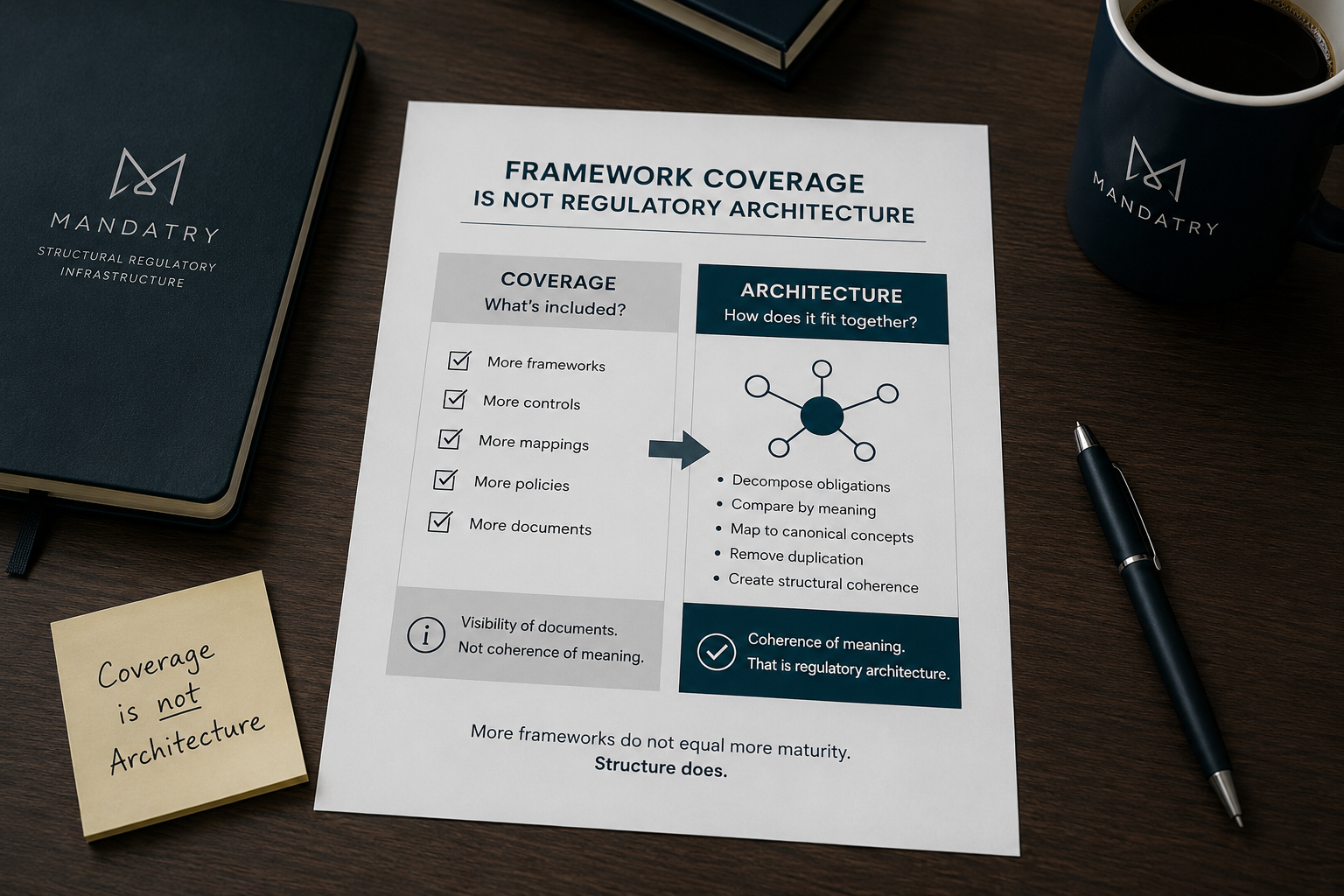
Framework Coverage Is Not Regulatory Architecture
Many compliance teams measure maturity by the number of frameworks they track. But framework coverage is not the same as regulatory architecture. Without structural coherence beneath the stack, organisations can accumulate coverage while still duplicating obligations, mappings and interpretation.
Many regulated organisations measure compliance maturity by coverage.
They look at the number of frameworks in scope, the number of jurisdictions being tracked, the number of controls mapped, and the number of standards, laws, policies and internal requirements recorded in their systems.
At first, this feels like a sensible measure of progress. A broader inventory appears to reduce blind spots. More frameworks suggest greater completeness. More mappings suggest more control. For teams operating under pressure, the act of capturing another framework can feel like a step towards maturity.
But framework coverage is not the same as regulatory architecture.
An organisation can track many frameworks and still lack structural coherence beneath them. It can maintain a large control library and still duplicate obligations. It can map regulations repeatedly and still fail to understand which requirements are genuinely distinct, which are structurally similar, and which are different expressions of the same underlying obligation.
Coverage answers one question: what has been included?
Architecture answers a different question: how does it all fit together?
That distinction matters because compliance complexity does not come only from missing frameworks. It also comes from weak structure between the frameworks already captured.
The coverage mindset
The coverage mindset begins with inclusion.
A new regulation appears. A new standard becomes relevant. A customer asks about a framework. A jurisdiction introduces another obligation set. A business unit expands into a new market. The organisation responds by adding more material to the compliance estate.
A framework is loaded. A spreadsheet is created. A control mapping is commissioned. A policy cross-reference is added. An advisory workpaper explains how the new material should be understood. Owners are assigned and the new framework becomes part of the visible compliance environment.
None of this is wrong. Enterprises cannot ignore new frameworks or regulatory expectations. Coverage is necessary because organisations need to know which bodies of regulation, standards and governance expectations are relevant to their operations.
The problem is that coverage can create the appearance of maturity before the underlying structure is coherent.
When teams focus mainly on whether a framework has been captured, they may not ask whether its obligations have been normalised against the rest of the regulatory estate. They may know that the framework is present, but not whether its requirements have been decomposed, compared, mapped and understood in relation to existing obligations.
The organisation ends up with more content, but not necessarily more coherence.
Why more frameworks can increase disorder
Every framework brings its own language. It has its own headings, definitions, numbering, legal form, control expectations and internal logic. It may describe familiar obligations in unfamiliar words. It may divide a known requirement across several provisions. It may combine concepts that another framework keeps separate.
Without a structural layer beneath the inventory, each new framework becomes another local model.
That is where disorder starts to accumulate. The same obligation may be interpreted more than once. Similar requirements may receive different labels. Controls may be mapped repeatedly. Evidence expectations may be recreated in different forms. Teams may spend time debating wording when the deeper question is whether the underlying regulatory structure is actually the same.
The result is not simply a larger compliance estate. It is a less governable one.
This is why framework coverage can become misleading. A dashboard may show that many frameworks are tracked, but the underlying structure may still be fragmented. The organisation has visibility of documents, but not necessarily coherence of meaning.
The unit of coverage is often wrong
One reason this happens is that organisations often count the wrong unit.
They count frameworks, controls, policy documents and mapped rows. Those units are useful for administration, but they are not always the right units for regulatory architecture.
A framework is not atomic. It contains many obligations.
A control is not the same as an obligation. It is usually the organisation's operational response to one or more obligations.
A policy is not the same as regulatory structure. It is an internal expression of expected behaviour, governance decisions and organisational standards.
A mapped row is not automatically a governed relationship. It may represent a local interpretation, a project decision, a point-in-time assessment or a temporary workaround.
Regulatory architecture needs a more stable unit of comparison. It needs to understand the underlying obligations and concepts that recur across frameworks, jurisdictions and standards. Without that layer, teams are forced to compare large blocks of text, control statements and framework sections directly against each other.
That is where duplication begins.
The problem beneath the inventory
Most enterprises already have systems for managing compliance activity. They may have GRC platforms, regulatory monitoring tools, control libraries, policy repositories, advisory support and internal spreadsheets.
Those systems are valuable. They help teams track work, manage ownership, evidence controls, document policies and respond to regulatory change.
But they often operate above the structural layer.
They do not necessarily create a canonical model of regulatory meaning beneath those activities. They may show that a control has been mapped to a framework, but not whether the obligation behind that mapping is structurally equivalent to another requirement elsewhere. They may show that a regulation has been reviewed, but not whether its concepts have been normalised across the wider estate.
When the structural layer is absent, each operational system develops its own version of regulatory meaning.
The GRC platform has one model. The control library has another. The policy team has another. The legal team has another. The audit team has another. External advisers may introduce yet another.
Over time, the organisation does not have one regulatory architecture. It has many overlapping interpretations of regulation, each embedded in a different workflow or artefact.
Framework coverage increases, but structural coherence does not.
What regulatory architecture requires
Regulatory architecture begins by asking different questions.
It still asks which frameworks are tracked, because coverage remains important. But it also asks which obligations are structurally similar, which requirements are genuinely new, which concepts recur across jurisdictions, which mappings are authoritative, and which terms are synonyms rather than distinct ideas.
It asks whether an obligation has already been represented elsewhere. It asks whether a framework adds new structure to an existing baseline. It asks whether similar wording hides important differences, or whether different wording expresses the same underlying regulatory meaning.
These are architectural questions. They cannot be answered reliably by coverage counts alone.
They require a governed way to decompose frameworks into comparable parts, normalise terminology and map obligations through stable concepts. This does not remove expert judgement. It gives expert judgement a clearer structural substrate.
Without that substrate, judgement remains trapped in individual projects, spreadsheets, mapping exercises and local decisions. The organisation may have many interpretations, but no durable architecture.
Why coverage feels safer than architecture
Coverage feels concrete.
A team can show a list of frameworks. It can point to a mapped control set. It can report that a regulation has been reviewed. It can add another row to a tracker and demonstrate visible progress.
Architecture is harder to see because it lives in the relationships between obligations, concepts, mappings, frameworks and versions. It is less obvious than a spreadsheet and less familiar than a control library.
That is why many organisations underinvest in it.
They keep adding more coverage because coverage is easier to explain. The cost appears later, when teams need to compare, reuse, update or defend the structure they have built.
A new framework arrives and the same analysis starts again. A regulator changes wording and teams cannot tell what has structurally changed. A business unit asks whether two regimes overlap and the answer depends on which spreadsheet is used. A control appears to satisfy many requirements, but the underlying obligation mapping is unclear.
These are not failures of effort. They are symptoms of weak regulatory architecture.
Structural coherence changes the operating model
When frameworks are decomposed into atomic obligations and aligned through a governed canonical model, the organisation gains a different kind of visibility.
It can see where frameworks share structure. It can see where terminology differs but meaning overlaps. It can see where an incoming framework adds genuinely new obligations. It can see where existing mappings need review. It can compare regulatory regimes without treating every framework as a separate universe.
This changes the economics of compliance work.
Instead of repeatedly rebuilding interpretation from scratch, teams can build on a common structural layer. Instead of multiplying local mappings, they can reuse governed concepts. Instead of treating every framework addition as a new architecture, they can assess how that framework fits into the architecture they already have.
That does not mean every framework becomes the same. Differences still matter. Legal force, jurisdiction, sector context, definitions, scope and supervisory purpose all need to be preserved.
Structural coherence is not about flattening regulation. It is about making similarity and difference visible enough to govern.
Why this matters now
The regulatory environment is not becoming simpler.
Enterprises face overlapping obligations across privacy, AI governance, cyber resilience, sustainability, financial services, operational resilience, human rights, sector conduct and reporting. Each area brings its own frameworks, terminology and operating expectations.
If every new framework is managed as a separate coverage exercise, organisations will continue to increase the surface area of compliance without improving the coherence beneath it. They will know more documents, but not necessarily understand the relationships between them.
That creates long-term cost.
The cost is not only that there is more regulation to manage. It is that the same underlying work is repeated in slightly different forms. Obligations are reinterpreted. Controls are remapped. Evidence expectations are rebuilt.
Terminology is debated again. Cross-framework comparison depends on manual reconciliation.
The issue is not just regulatory volume.
It is structural fragmentation.
What Mandatry is doing
Mandatry is built for this structural layer.
It decomposes regulatory frameworks into atomic obligations and aligns them through a governed canonical model. That makes it possible to understand frameworks not only as documents to be tracked, but as structured regulatory architectures that can be compared, mapped and normalised.
Mandatry does not replace GRC systems, monitoring tools, control libraries, policy repositories, legal teams or advisory work. It does not provide legal advice, assign remediation tasks, certify compliance, score readiness or determine customer applicability.
Its role is different.
Mandatry sits beneath those systems as Structural Regulatory Infrastructure. It helps make the regulatory structure those systems depend on more coherent by supporting canonical regulatory concepts, atomic obligation modelling, cross-framework structural comparison, terminology normalisation, jurisdictional composability and structural regulatory alignment.
That is not compliance scoring. It is not certification. It is not a workflow layer.
It is the normalisation layer beneath the compliance stack.
The next stage is architecture
Framework coverage matters, but it is not enough.
A regulated enterprise can know which frameworks it tracks and still lack a coherent understanding of how those frameworks relate to one another. It can expand its control library and still duplicate interpretation. It can map more requirements and still fail to govern the meaning beneath those mappings.
The next stage of compliance maturity is not simply more coverage. It is better architecture.
Because once the regulatory estate becomes structurally coherent, every downstream system has a stronger foundation. GRC becomes less fragmented. Control libraries become easier to rationalise. Framework comparisons become more dependable. Change becomes easier to interpret. Regulatory expansion becomes less duplicative.
That is the difference between tracking frameworks and building Structural Regulatory Infrastructure.
Explore Structural Regulatory Infrastructure
See how Mandatry makes regulatory frameworks structurally comparable through atomic obligations and canonical concepts.