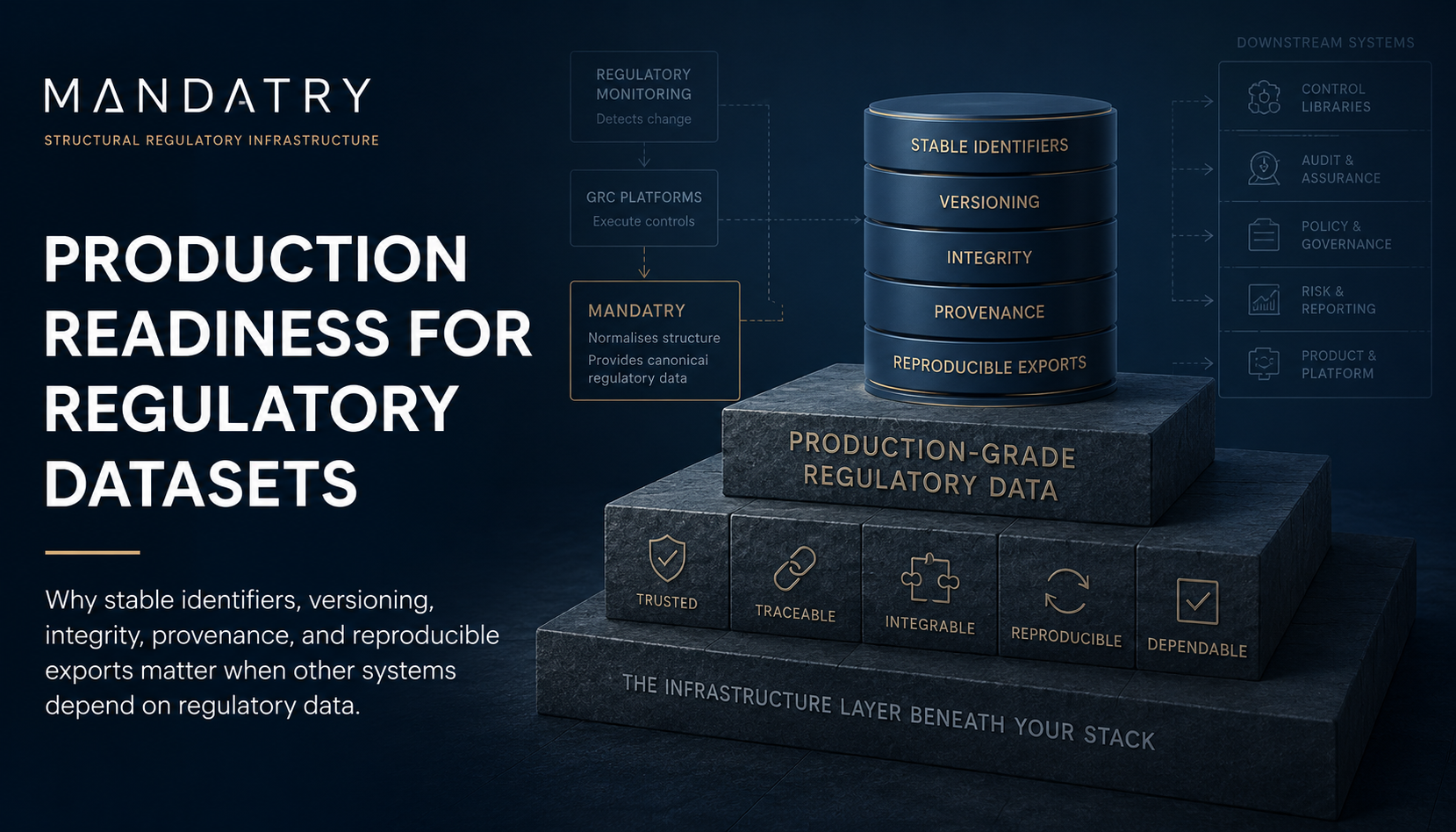
Production Readiness for Regulatory Datasets
Most regulatory repositories are readable but not production-grade. This article explains why systems integration requires stable identifiers, versioning, integrity constraints, provenance, and reproducible exports rather than mostly consistent datasets.
Most regulatory repositories are complete enough for reading.
Very few are production-grade for systems integration.
That difference matters more than it sounds.
A dataset can be useful for analysts, researchers, or legal teams and still be unfit for live operational dependency. It can be searchable, broad, and reasonably well maintained, yet still fail when another system tries to rely on it as a stable source of regulatory structure.
That is the gap between a library and infrastructure.
Most repositories stop at readable
A readable repository helps people look things up. It gives them documents, extracts, summaries, and maybe some metadata. That has real value. It supports research, interpretation, and human review. But readable is not the same as dependable.
Once a GRC platform, audit automation layer, policy engine, product governance process, or cross-jurisdiction mapping service depends on regulatory data, the standard changes.
At that point, mostly consistent is not enough. The dataset has to behave like infrastructure.
What production-grade means
A production-grade regulatory dataset is not defined by volume alone.
It is defined by whether its structure can be trusted across repeated use.
That usually requires
→ stable identifiers for obligations and concepts
→ explicit versioning and lifecycle states such as draft, certified, and deprecated
→ integrity constraints so there are no orphan mappings, duplicate nodes, or broken references
→ provenance tracking including source, citation paths, and change history
→ reproducible exports that behave consistently across runs and environments
These are not cosmetic qualities. They are what allow the dataset to function as a reliable dependency rather than a helpful repository.
Why this matters in live systems
The moment regulatory data feeds other systems, the cost of inconsistency rises sharply.
A broken mapping is no longer just an inconvenience for an analyst. It can propagate into control libraries, audit workflows, product decisions, reporting logic, or policy obligations downstream.
That is why production readiness is not a nice to have. It is the minimum standard for safe reuse.
If one team consumes a dataset for crosswalk analysis, another uses it for control mapping, and a third uses it for governance reporting, all of them need confidence that the underlying objects are stable, traceable, and versioned.
Without that, every downstream system ends up carrying hidden uncertainty.
A library and infrastructure are not the same
A library is where you look things up. Infrastructure is what other systems depend on.
That is the simplest distinction.
Libraries are optimised for access.
Infrastructure is optimised for reliability.
A library can tolerate some ambiguity because the human reader is expected to resolve it.
Infrastructure cannot depend on that assumption at scale.
If a regulatory dataset is going to sit beneath GRC, audit automation, policy systems, or internal governance tooling, it has to support deterministic reference behaviour.
The consumer system needs to know
→ what this obligation is
→ whether it still exists in the same state
→ what changed between versions
→ what it maps to
→ where it came from
→ whether the same export can be generated again
That is a much higher standard than readability.
Where repositories usually fail
Most repositories fail production readiness in predictable ways. They often contain useful content, but lack the structural guarantees needed for system dependency.
Typical problems include
→ identifiers that change when formatting changes
→ mappings that exist without strong lifecycle control
→ records with missing provenance or unclear source lineage
→ duplicated concepts that survive because there is no governed reference model
→ exports that differ across runs because the underlying logic is not fully stable
None of these issues necessarily breaks the repository for human use. But they do break trust once the dataset becomes part of a wider operating environment.
That is the important point.
Production readiness is not about whether the data is interesting. It is about whether other systems can safely rely on it.
A simple example
Imagine a control mapping engine consuming a regulatory dataset to support cross-framework alignment.
If the obligation identifiers are unstable, a downstream control relationship may break when the source is refreshed.
If lifecycle states are unclear, a deprecated requirement may still be treated as active.
If provenance is incomplete, an auditor may not be able to trace why a mapping exists.
If exports are not reproducible, two teams may run the same query and receive structurally different outputs.
Each problem looks technical. But the business consequence is practical.
Trust erodes.
Teams start keeping manual overlays.
Spreadsheets reappear.
The dataset remains present, but the system no longer behaves like shared infrastructure.
What production readiness changes
When a regulatory dataset becomes production-grade, the economics and usability of the stack improve.
It becomes easier to
→ integrate regulatory structure into downstream systems
→ govern changes without breaking dependencies
→ certify which records are ready for operational use
→ defend mappings with traceable provenance
→ reuse exports across teams without revalidation every time
This is what changes the role of the dataset. It stops being a passive repository and becomes an operational substrate.
That is the point where regulatory information becomes part of enterprise architecture rather than remaining reference material.
Why governance is part of the dataset
Production readiness is not just a data engineering issue. It is also a governance issue.
A dataset becomes infrastructure only when structural decisions are governed over time.
That means the system needs a way to manage
→ concept creation and retirement
→ obligation certification
→ mapping approval
→ version transitions
→ deprecation and replacement rules
Without governance, the dataset may still grow. But it does not mature.
It becomes larger without becoming more dependable. That is why production readiness and governance belong together.
What Mandatry changes
Mandatry is designed to support production-grade regulatory structure rather than merely readable regulatory repositories.
That means treating regulatory obligations as governed structural objects, not just pieces of text in a database.
In practical terms, that means focusing on
→ stable obligation and concept references
→ governed lifecycle states
→ structurally validated mappings
→ traceable provenance
→ reproducible outputs for downstream consumption
This is the difference between a repository that helps people read regulation and infrastructure that helps other systems depend on regulatory structure safely.
The strategic point
The compliance market already has many places to store, search, and review regulatory material.
What it has far less of is production-grade regulatory structure.
That is the missing layer.
As more systems begin to rely on regulatory data for control mapping, audits, policy alignment, product governance, and cross-jurisdiction analysis, the tolerance for structural inconsistency will fall.
At that point, readable will not be enough.
The market will increasingly distinguish between repositories that are useful to consult and datasets that are safe to build on.
That is what production readiness means in this category.
Explore Structural Regulatory Infrastructure
See how Mandatry makes regulatory frameworks structurally comparable through atomic obligations and canonical concepts.