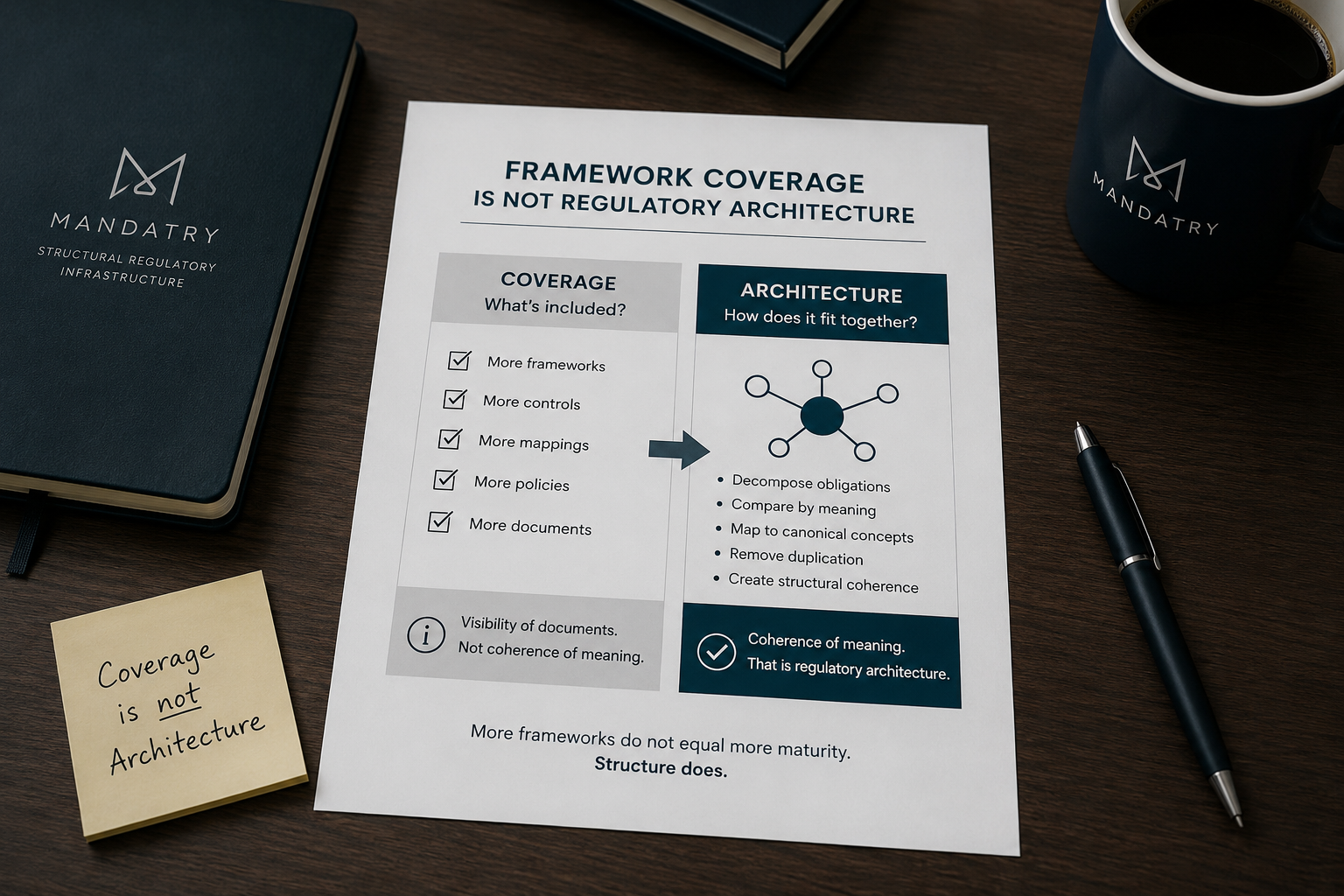
The EU AI Act Will Test Regulatory Architecture, Not Just AI Policies
The EU AI Act will test more than whether organisations have written AI policies. It will test whether they can represent AI obligations structurally across transparency, general-purpose AI, governance, documentation, oversight, risk management and wider compliance architecture.
The EU AI Act is often discussed as a policy challenge. Organisations need AI policies, governance committees, acceptable use rules, vendor review processes, model inventories and internal guidance. Those artefacts are important, and many organisations are right to develop them.
But the AI Act will test something deeper than policy readiness.
It will test whether organisations have regulatory architecture.
AI governance obligations do not sit neatly inside one document, one team or one workflow. They cut across transparency, documentation, human oversight, risk management, data governance, accountability, general-purpose AI, third party use, product governance, cyber security, privacy and assurance. As implementation continues, the challenge will not only be whether organisations have responded to AI regulation. It will be whether they can understand how AI obligations relate structurally to the compliance architecture they already operate.
A policy can express a position. It cannot, by itself, normalise regulatory meaning.
Policies are necessary, but they are not the architecture
AI policies play an important role. They help organisations communicate expectations, set internal boundaries, guide employees, define escalation routes and explain how AI should be used responsibly. A good policy can reduce confusion and create a visible governance stance.
But a policy is an internal expression of decisions. It is not the regulatory structure itself.
A single AI policy may refer to many different obligation types: transparency, prohibited use, human review, vendor due diligence, record keeping, training, data protection, security, risk assessment and documentation. It may simplify legal language for internal users, combine several requirements into practical rules and reflect organisational risk appetite.
That is useful policy work. But it does not answer the structural questions beneath the policy.
Which obligations are AI-specific? Which are extensions of existing privacy, cyber or governance obligations? Which transparency duties overlap with existing disclosure practices? Which documentation obligations relate to auditability? Which third party requirements connect to vendor governance? Which requirements are genuinely new, and which reuse familiar regulatory patterns?
Those are architecture questions, not policy drafting questions.
Transparency is a structural obligation, not just a notice
Transparency is one of the clearest examples.
At first glance, transparency can sound like a communications issue. Tell users when they are interacting with AI. Mark certain AI-generated content. Provide information in the right context. Make the interaction clearer.
But transparency is not only a notice problem. It has structural consequences.
An organisation needs to understand which systems create transparency questions, which user interactions are affected, which outputs require disclosure, which systems are internal or external, which content is generated or manipulated, which users are involved and which other governance obligations connect to the same process.
Transparency also overlaps with other regulatory domains. Privacy frameworks already contain transparency obligations. Consumer protection regimes may require clear information. Financial services rules may impose disclosure expectations. Product governance may require information about system behaviour. Internal governance may require documentation of how AI is used in decision processes.
This means AI transparency should not be treated as a standalone policy paragraph. It needs to be mapped into the wider regulatory architecture so that organisations can understand where it is new, where it overlaps and where it depends on existing governance structures.
GPAI makes the architecture more layered
General-purpose AI adds another layer of complexity because it separates parts of the AI value chain that many organisations previously treated together.
A provider of a general-purpose AI model, a provider of an AI system, a deployer, an integrator, a downstream user and an enterprise customer may all sit in different places in the ecosystem. Their responsibilities, documentation needs and governance expectations may differ.
This creates a structural problem before it creates an operational one.
The organisation needs to understand which role it plays in relation to a given AI system or model, how that role changes across use cases, which obligations attach to which actor, and how internal procurement, deployment, risk review and monitoring processes should represent those differences.
A simple AI policy may say that AI use must be approved or that vendors must be assessed. That is useful, but it does not model the relationships between actors, models, systems, use cases, documentation, transparency obligations and downstream governance.
GPAI makes role clarity, obligation mapping and lifecycle structure more important because the same organisation may be a user in one context, an integrator in another and a provider in another. Treating all AI activity as one category will not be enough.
AI governance crosses existing compliance domains
The EU AI Act is AI-specific, but AI governance is not isolated from the rest of the compliance estate.
Many AI obligations intersect with existing domains. Data governance connects to privacy and information management. Security connects to cyber and digital trust. Human oversight connects to accountability and risk management. Documentation connects to assurance and auditability. Third party AI use connects to procurement, outsourcing and supplier governance. Transparency connects to user communication, consumer protection and privacy. High-impact use cases may involve employment, financial services, healthcare, education or public sector governance.
If an organisation builds AI governance as a silo, it may recreate structures that already exist elsewhere.
A separate AI transparency process may duplicate privacy transparency. A separate AI vendor review may duplicate third party risk. A separate AI documentation process may duplicate audit and assurance requirements. A separate AI risk register may diverge from enterprise risk governance.
Some AI-specific structure will be needed. But without a canonical layer, organisations may struggle to see which obligations are new and which are new expressions of familiar governance patterns.
The risk of AI governance as a standalone operating model
Many organisations respond to major regulation by creating a dedicated operating model around it. That is understandable. A new regulation needs owners, meetings, workstreams, reports, policies, controls and evidence.
The risk is that the AI Act becomes its own isolated compliance universe.
If that happens, AI governance may develop its own vocabulary, mappings, evidence expectations, policy logic and control relationships separate from the rest of the compliance stack. The AI programme may become active and well managed, but structurally disconnected.
That creates long-term problems. Similar obligations may be interpreted differently across AI, privacy, cyber and operational risk. Controls may be mapped repeatedly. Evidence may be requested in different forms. A term such as transparency, oversight, documentation or risk management may mean different things in different teams.
The organisation may appear to have an AI governance programme, but lack a coherent AI regulatory architecture.
The implementation challenge is not only timing
Regulatory implementation dates matter, but timing should not become the whole conversation. Focusing only on dates can make AI governance feel like a sequence of deadlines, tasks and policy updates.
The more durable question is structural.
What does the organisation need to represent so that AI obligations can be understood, compared, maintained and updated over time?
The answer is not just a calendar. It is a model. Organisations need a way to represent frameworks, provisions, obligations, concepts, roles, mappings, lifecycle states, source references and relationships to existing controls and policies.
This is especially important because AI regulation will continue to evolve. Guidance will develop. Standards will mature. Supervisory expectations will become clearer. Use cases will change. Model supply chains will shift. Internal adoption will expand.
A deadline-focused response may help with the next milestone. A structural response helps the organisation maintain AI governance across many future changes.
Inventories are not enough
AI inventories are valuable. They help organisations understand where AI systems are used, who owns them, what purpose they serve, which vendors are involved and which risk reviews may be needed.
But an inventory is not the same as regulatory architecture.
An inventory tracks AI systems or use cases. Regulatory architecture explains the obligations and concepts that apply around them. The inventory may show that a system exists, but it may not show how transparency obligations connect to documentation duties, how vendor review connects to third party oversight, or how human oversight connects to existing accountability structures.
If the inventory becomes the main governance object, organisations may track use cases without fully understanding the regulatory structure those use cases depend on.
The stronger model is to connect inventories to a governed obligation and concept layer. That allows the organisation to understand not only which AI systems exist, but how the regulatory architecture around those systems is structured.
Documentation needs structural consistency
AI governance places significant weight on documentation. Organisations need records, descriptions, assessments, policies, technical information, governance evidence and decision histories. Documentation is essential, but documentation becomes difficult when the underlying structure is inconsistent.
Different teams may document AI systems using different terms. Vendor assessments may use one taxonomy, privacy assessments another, security reviews another and business approvals another. A model inventory may not align with procurement records. A transparency review may not align with customer communication processes. A risk assessment may not map cleanly to control evidence.
The problem is not lack of documentation. It is lack of structural consistency across documentation.
A governed architecture helps documentation become reusable rather than fragmented. It gives teams stable concepts, obligations and mappings so that evidence and records are connected to the same underlying model.
AI governance needs change memory
AI governance will not be a one-time implementation exercise. Frameworks will be interpreted, guidance will be refined, standards will be developed and internal AI use will change.
That means organisations need change memory.
They need to know why a use case was classified a certain way, why a transparency decision was made, why a vendor was treated as relevant, why a mapping was accepted, why a control was linked to an AI obligation and why a concept boundary changed.
Without that memory, AI governance becomes difficult to maintain. Teams revisit old decisions, reinterpret familiar obligations, duplicate evidence requests and struggle to explain why the structure looks the way it does.
A designed regulatory architecture preserves decisions over time. It allows organisations to update AI governance without losing the rationale behind earlier structural choices.
Controls should come after obligation structure
Controls are essential to operational response, but they should not become the first representation of AI regulatory meaning.
If AI obligations are mapped directly to controls without a clear obligation and concept layer, the organisation may compress important differences too early. Several transparency obligations may be mapped to one communication control. Several documentation duties may be mapped to one record keeping control. Several oversight requirements may be mapped to one governance control.
That may be operationally convenient, but it can hide structural nuance.
The organisation still needs to know what each obligation requires, which concept it expresses, whether it overlaps with other obligations and whether the control supports it fully or only partially.
A control is the response. It should not be forced to become the regulatory model.
AI regulation will expose weak meaning management
AI regulation is likely to expose a broader weakness in many compliance stacks: weak management of regulatory meaning.
Organisations may have tools for policies, controls, risks, tasks and evidence. They may also have monitoring sources for regulatory updates. But they may not have a governed way to represent obligations and concepts across frameworks.
AI makes that gap visible because its obligations cut across so many existing areas. It brings together data, security, transparency, accountability, product governance, procurement, human oversight and assurance. If those areas already use different vocabularies and mapping logic, AI governance will amplify the inconsistency.
The question is not simply whether the organisation has an AI policy. The question is whether the organisation has a stable model of AI regulatory meaning that downstream systems can depend on.
What enterprises should ask
A structural response to the AI Act starts with better questions.
Which obligations are being represented? Which concepts recur across AI, privacy, cyber, procurement and assurance? Which AI-specific requirements are genuinely new? Which mappings are direct, partial or uncertain? Which internal policies express the organisation's response, and which source obligations do they respond to? Which controls support which obligations? Which documentation is evidence of operation, and which documentation is part of the obligation itself?
These questions help organisations avoid treating AI governance as a set of disconnected artefacts.
They also help preserve boundaries. Structural analysis does not tell the organisation whether it is legally in scope or what it must do operationally. It gives legal, risk, compliance, privacy, security and business teams a clearer substrate for review and action.
That is the role of regulatory architecture.
What Mandatry is doing
Mandatry is built for the structural layer beneath AI governance and wider compliance operations.
It decomposes regulatory frameworks into atomic obligations and aligns them through a governed canonical model. That makes it possible to understand how AI obligations relate to broader regulatory architecture across domains such as privacy, digital trust, operational resilience, assurance, sector conduct and governance.
Mandatry does not provide legal advice, determine customer applicability, certify compliance, score readiness or assign remediation tasks. It does not replace AI governance teams, legal teams, GRC platforms, monitoring tools, control libraries, policy repositories or advisory processes.
Its role is different.
Mandatry helps make the regulatory structure beneath those systems more coherent. For AI governance, that means helping organisations understand obligations, concepts and mappings before policies, controls and workflows grow around them.
The EU AI Act needs architecture, not just policy
The EU AI Act will test more than whether organisations have AI policies. It will test whether they can represent AI obligations structurally across transparency, general-purpose AI, documentation, oversight, risk management, third party use and wider compliance architecture.
Policies will remain necessary. Inventories will remain useful. Controls will remain important. Monitoring will remain valuable.
But none of those layers replaces the need for regulatory architecture.
Without a governed meaning layer, AI governance will fragment into policies, registers, workpapers, local mappings and control interpretations. With a structural layer, organisations can understand how AI obligations relate to the regulatory estate they already manage.
That is the difference between responding to AI regulation as another compliance project and building AI governance on Structural Regulatory Infrastructure.
Explore Structural Regulatory Infrastructure
See how Mandatry makes regulatory frameworks structurally comparable through atomic obligations and canonical concepts.