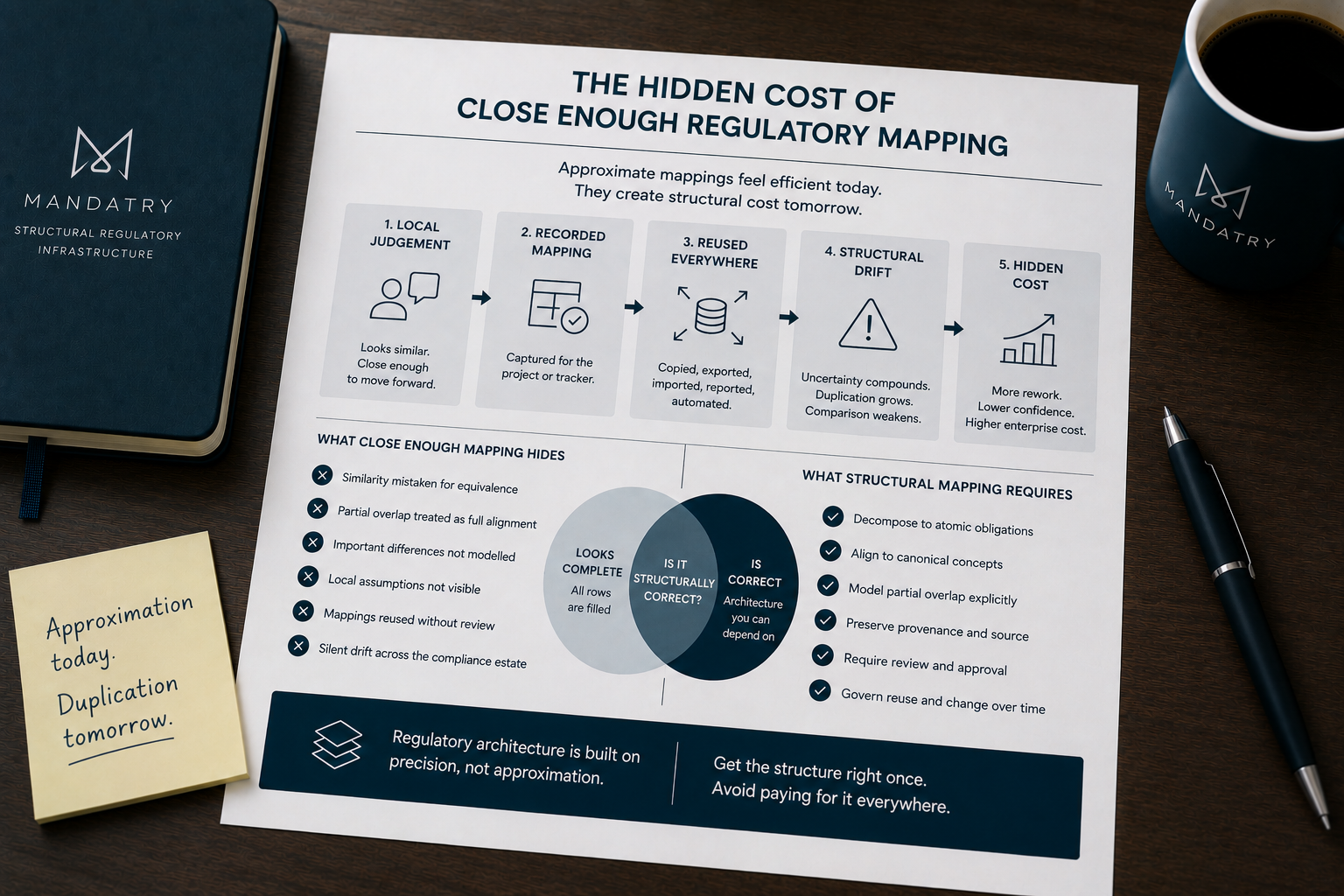
The Hidden Cost of Close Enough Regulatory Mapping
Regulatory mappings often look acceptable when they are close enough for a project. But approximate mappings compound over time. Without a governed structural layer, small mapping decisions can create duplicated obligations, weak comparisons and silent drift across the compliance estate.
Most regulatory mapping problems do not begin with obvious mistakes.
They begin with decisions that look reasonable at the time. A requirement appears similar to one already mapped. A control seems to support the obligation. A framework section looks close enough to an existing concept. A partial overlap is accepted because the wording is familiar. A spreadsheet row is reused from an earlier project. A reviewer approves the mapping because it is sufficient for the immediate purpose.
Nothing looks broken.
The problem appears later, when those small decisions are reused, copied, exported, reported, automated or treated as authoritative. What began as a practical judgement for one project becomes part of the organisation's regulatory architecture.
That is the hidden cost of close enough regulatory mapping.
Approximate mappings may help a team move forward in the short term, but they can create structural drift over time. The organisation may believe it has built alignment, when it has actually accumulated a chain of assumptions that were never designed to carry enterprise weight.
Mapping decisions compound
A regulatory mapping is rarely just a local judgement.
Once recorded, it can influence many downstream activities. It may affect control alignment, evidence expectations, policy updates, framework comparison, reporting, audit preparation, system configuration and future mapping decisions. It may be copied into another spreadsheet, imported into a control library, reused by another team or treated as the precedent for a later review.
This is why mapping quality matters.
A weak mapping does not always stay isolated. It travels through the compliance stack. Once it travels, it becomes harder to distinguish the original judgement from the structure that has grown around it.
A mapping that was created for one purpose may later be used for another. A caveat that was understood by the original team may not be visible to downstream users. A relationship that was acceptable as a working assumption may become a reference point for enterprise reporting.
That is how small mapping decisions compound.
Similarity is not equivalence
Regulatory obligations often look similar without being the same.
Two requirements may use similar language, refer to similar activities, point to similar controls, sit in the same domain or appear under comparable headings. It is natural for a team to see resemblance and decide that the relationship is close enough.
But similarity is not equivalence.
One obligation may be broader than another. One may be narrower. One may include a reporting duty, while another requires internal documentation only. One may depend on a defined trigger, while another applies continuously. One may sit inside a particular jurisdiction, sector or legal form, while another may belong to a general standard.
Those differences matter.
If they are not preserved, the mapping becomes misleading. The organisation may believe it has found structural alignment when it has only found resemblance. That distinction is especially important when mappings are reused beyond the original project context.
A close match is not necessarily a governed relationship.
Partial overlap is not failure
Many mapping problems come from treating partial overlap as if it were full alignment.
This is easy to do. A requirement appears to match an existing control, concept or obligation, but only in part. The project needs to move forward, so the mapping is recorded. The limitation may be noted informally, left in a comment, captured in a colour code or discussed in a meeting.
Later, the caveat disappears. The mapping remains.
A partial relationship starts to look like an authoritative one.
The problem is not partial overlap itself. Partial overlap is a legitimate structural state. Many frameworks partially overlap. Many obligations share some elements without being identical. Many controls support part of a requirement without addressing the whole of it.
The problem is failing to model partial overlap clearly.
If a mapping can only express full alignment or no alignment, teams are pushed towards false certainty. They either overstate the relationship or lose the relationship altogether. A mature regulatory architecture needs room for nuance.
Close enough mapping creates false clarity
A clean mapping table can look convincing.
Every framework requirement has a mapped control. Every provision has a linked concept. Every row appears complete. Every gap appears resolved. From a reporting perspective, the table may look tidy and mature.
But a completed table can hide uncertainty.
It may not show which mappings are direct, which are partial, which are inferred and which require review. It may not show whether the mapping was based on source text, operational judgement, historical reuse or convenience. It may not show whether the relationship has been challenged since it was first created.
This creates false clarity.
The structure looks complete because every cell is filled, but completeness at the row level is not the same as confidence at the structural level.
For enterprise compliance, that distinction matters. A mapping table is not only a record of work done. It can become a model that systems, controls, reports and teams depend on.
If uncertainty has been compressed out of the model, downstream users inherit confidence that the structure may not deserve.
Mapping debt grows quietly
Approximate mappings become more dangerous as the compliance estate grows.
When an organisation has a small number of frameworks, a weak mapping may be noticed and corrected manually. People remember the context. The team that made the decision is still available. The mapping can be revisited without major disruption.
At enterprise scale, the position is different.
There may be dozens of frameworks, many jurisdictions, multiple control libraries, external advisers, several internal teams and numerous downstream systems. A weak mapping can persist because no one has the full context or because too many processes now depend on it.
One close enough decision influences another. A reused mapping becomes a precedent. A local concept becomes embedded in a global model. A synonym survives because it already appears in several files. A control is treated as covering more than it really does. A framework comparison depends on a relationship that no one wants to reopen.
Over time, the organisation builds on accumulated approximation.
That is mapping debt.
Mapping debt is structural debt
Technical debt is a familiar idea. Mapping debt works in a similar way.
It is the accumulation of earlier shortcuts, approximations and unresolved decisions inside the regulatory structure. At first, the debt is easy to ignore because the system still appears to work. Reports can be generated. Controls are mapped. Frameworks appear covered. Evidence requests can be issued.
The weakness becomes visible only when the structure is tested.
A new framework does not fit the existing model. A regulator updates wording and the organisation cannot tell what changed structurally. Two teams disagree about whether an obligation is already covered. A control is mapped to too many requirements. A concept has become too broad to be useful. A historical mapping is difficult to defend.
The problem was not created on the day it was discovered.
It was built gradually through close enough decisions that were never governed as architecture.
The control layer can hide the issue
Control mappings often make close enough decisions look safer than they are.
A control may be broad enough to support several obligations. That can be operationally useful, especially where organisations are trying to reduce duplicated activity and evidence requests.
But if the underlying obligation relationships are not governed, the control mapping may hide structural uncertainty.
For example, several obligations may all map to a third party risk control. One may concern vendor due diligence. Another may concern ongoing monitoring. Another may concern subcontractor transparency. Another may concern incident notification. Another may concern contractual rights.
The shared control relationship may be real, but the obligations are not identical.
If the organisation treats the shared control as proof of full regulatory alignment, it loses important structure. It may be able to say that one control supports several requirements, but not whether those requirements are equivalent, partially overlapping or distinct.
Control similarity is not the same as obligation equivalence.
Spreadsheets make approximation easy to hide
Spreadsheets remain common because they are flexible. They allow teams to compare frameworks quickly, add notes, create mappings, mark confidence, insert comments and move a project forward.
That flexibility is useful. It is also one reason approximation survives.
A team can mark a requirement as mapped, add a note explaining the reasoning, use a colour to indicate confidence and leave a comment flagging uncertainty. In the original context, those signals may be understood.
But they often do not survive.
They may be lost when the file is copied. They may be ignored when the table is imported. They may be removed when the mapping is simplified for reporting. They may be interpreted differently by another team. They may become unreadable when the project team has moved on.
The spreadsheet supports the project, but it does not enforce governance.
That is why close enough mapping persists. The medium allows decisions to be recorded without requiring the structure to remain governable.
Confidence needs to be modelled
Not every mapping has the same level of confidence.
Some relationships are direct. Some are partial. Some are inferred. Some are uncertain. Some require human review. Some are historical and need reassessment. Some should not be reused without further analysis.
A mature regulatory architecture should represent those differences.
Mapped or not mapped is too crude. Covered or not covered is too crude. Equivalent or different is too crude.
Regulatory structure often needs more careful classification. The organisation should be able to show that one relationship is structurally aligned, another partially overlaps, another appears net new, another requires review, another has been deprecated and another should not be reused.
That is how mapping becomes governable.
It also protects downstream systems. A system consuming mapping data should not treat every relationship as equally dependable. A reviewed mapping should carry a different status from a provisional suggestion. A partial overlap should not be silently consumed as full equivalence.
Governance matters more than perfection
The answer is not to demand perfect certainty.
Regulation involves interpretation. Frameworks differ. Source material can be ambiguous. Expert judgement remains necessary. Some mappings will always require review, discussion and revision.
The goal is not perfection. The goal is governed uncertainty.
A strong regulatory architecture should make uncertainty visible. It should distinguish stable structure from judgement that needs review. It should preserve provenance. It should record why mappings were accepted, rejected, merged, split or retired. It should allow teams to revisit decisions without having to reconstruct the entire history from old spreadsheets and project notes.
This is what close enough mapping lacks.
It often compresses uncertainty into a clean answer. That may help a project finish, but it does not help the enterprise maintain structural integrity over time.
A governed model can tolerate uncertainty because it does not pretend uncertainty has disappeared.
Canonical concepts improve mapping discipline
Canonical concepts help reduce close enough mapping by giving teams a stable comparison layer.
Instead of mapping every framework requirement directly to every other framework, control or policy, obligations can be aligned through governed concepts. That changes the discipline of mapping.
The team is not only asking whether two pieces of text look similar. It is asking whether the obligation belongs to an existing structural concept, whether that concept is appropriate, whether the relationship is direct, partial, distinct or uncertain, and whether previous mappings can be reused safely.
This creates a more durable model.
Mappings become part of a governed architecture rather than isolated project artefacts. A concept can be reviewed. A mapping can be challenged. A partial overlap can remain visible. A retired relationship can be preserved for history without continuing to drive current decisions.
That does not remove the need for expert review.
It makes review reusable.
Why this matters for cross-framework comparison
Cross-framework comparison depends on mapping quality.
If mappings are approximate, comparisons will be approximate. If partial overlaps are treated as full alignment, overlap analysis becomes misleading. If concepts are duplicated, shared structure becomes harder to see. If broad controls are used as substitutes for obligation structure, framework comparison becomes operational rather than structural.
This matters because enterprises increasingly need to understand how frameworks relate across privacy, cyber, AI governance, operational resilience, sustainability, financial services and other regulated domains.
The organisation needs to know where structure is shared, where it is distinct and where human review is required.
It needs to understand whether a new framework adds genuinely new obligations or expresses familiar regulatory patterns in a different form.
Close enough mapping makes that harder.
It blurs the distinction between resemblance and alignment, between control support and obligation equivalence, and between local judgement and governed structure.
Automation can scale weak mappings
Automation can make mapping debt worse if the underlying structure is weak.
A tool can process mappings quickly. It can generate suggestions, populate tables, summarise requirements and compare documents. These capabilities may be useful, especially where teams are dealing with large bodies of regulatory material.
But if the structure is not governed, automation may scale approximation.
It may create more mappings without improving confidence. It may reinforce historical errors. It may treat linguistic similarity as structural equivalence. It may generate clean outputs on top of uncertain relationships.
The issue is not automation itself.
The issue is whether automation is operating on a dependable structural layer.
Without that layer, faster mapping can simply create faster drift. The organisation may produce more outputs, but the quality of the underlying architecture may not improve.
What enterprises should ask
When reviewing regulatory mappings, organisations should ask more than whether the table is complete.
They should ask what evidence supports the mapping, whether the relationship is direct or partial, whether the concept has been reused consistently, whether the mapped obligation is broader or narrower than the target, and whether the relationship depends on jurisdictional or sector context.
They should also ask whether the mapping has been reviewed, whether it can be reused safely, what happens if the source framework changes, whether uncertainty is visible and whether the mapping is connected to a governed canonical model.
These questions may make mapping feel slower at first.
But they reduce repetition, drift and rework over time. They help prevent project-level shortcuts from becoming enterprise-level structural debt.
What Mandatry is doing
Mandatry is built to make regulatory mapping structural rather than merely project-based.
It decomposes regulatory frameworks into atomic obligations and aligns them through a governed canonical model.
That makes it possible to represent shared concepts, partial overlap, unique structural concepts and items requiring review.
Mandatry does not treat mapping as a simple exercise in filling rows. It treats mappings as part of regulatory architecture.
Mandatry does not provide legal advice, certify compliance, score customer readiness, assign remediation tasks or determine customer applicability. It does not replace GRC platforms, monitoring tools, control libraries, legal teams or advisory review.
Its role is different.
Mandatry helps make the structure beneath those systems more coherent, so regulatory mappings can be governed, compared and reused with greater discipline.
Govern mapping as architecture
Close enough mapping is tempting because it helps teams move forward.
But over time, approximate mappings become expensive. They create false clarity, hide partial overlap, weaken comparison, duplicate interpretation, make change harder to understand and create structural debt beneath the compliance stack.
The answer is not to stop mapping. The answer is to govern mapping as architecture.
That means decomposing obligations, aligning them through canonical concepts, preserving provenance, modelling uncertainty and controlling lifecycle over time.
Because regulatory mapping is not just an administrative exercise. It is one of the foundations of Structural Regulatory Infrastructure.
Explore Structural Regulatory Infrastructure
See how Mandatry makes regulatory frameworks structurally comparable through atomic obligations and canonical concepts.