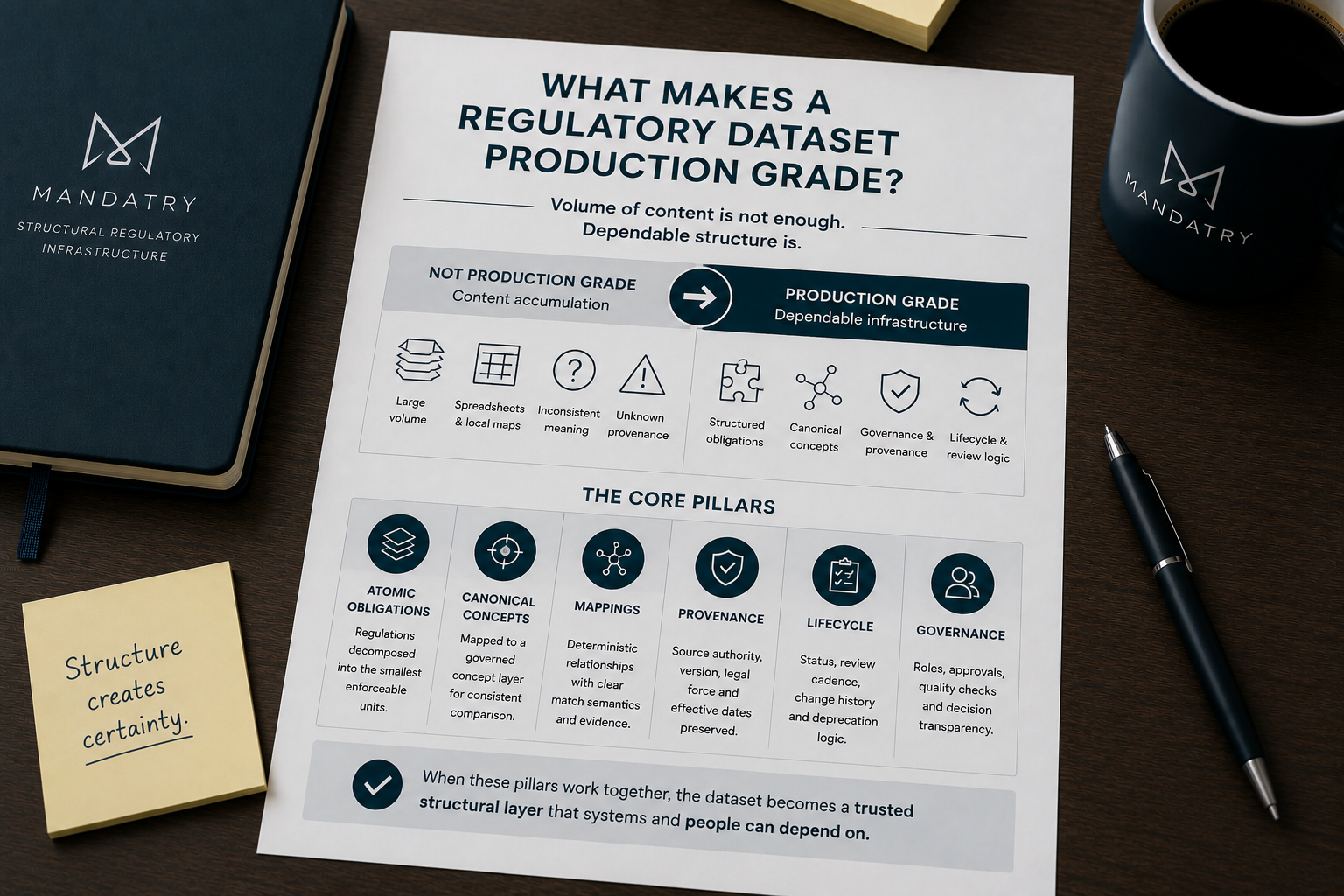
What Makes a Regulatory Dataset Production Grade?
A regulatory dataset is not production grade because it contains a large volume of legal or compliance content. It becomes production grade when its obligations, concepts, mappings, provenance, lifecycle and review logic are structured enough for enterprise systems to depend on.
Many organisations now have access to more regulatory content than ever.
They can subscribe to legal updates, search regulatory libraries, download frameworks, review guidance, generate summaries, assemble spreadsheets, build control mappings and maintain internal trackers. The volume of available material has increased significantly, and the tools for finding, storing and summarising that material are improving.
But access to regulatory content is not the same as having a production grade regulatory dataset.
A dataset becomes production grade only when other people, processes and systems can depend on it safely. That requires more than content volume. It requires structure, governance, provenance, reviewability and lifecycle discipline.
In other words, a production grade regulatory dataset is not defined by how much regulatory material it contains. It is defined by whether the organisation can trust the structure beneath that material.
Content volume is not maturity
It is easy to confuse a large regulatory dataset with a mature one.
A system may contain hundreds of frameworks, thousands of provisions and many mapped controls. It may look comprehensive. It may give users confidence that the organisation has captured a wide regulatory surface and reduced the risk of missing important material.
Scale alone does not make the dataset reliable.
A large dataset can still contain duplicated obligations, inconsistent terminology, local mappings that were never governed and unclear distinctions between source text, interpretation, controls, evidence notes and policy language. It can still lack provenance. It can still make it difficult to know which records are current, reviewed, deprecated, uncertain or retained only for historical traceability.
That is not infrastructure.
It is content accumulation.
Content accumulation may help teams find material, but it does not necessarily help them compare obligations, govern meaning or maintain structure over time. A production grade dataset needs to do more than hold information. It needs to make regulatory meaning dependable.
Production grade means dependable
A production grade regulatory dataset should behave like enterprise reference infrastructure.
That means the organisation can rely on it as a stable structural layer beneath downstream activity. It should support comparison, review, controlled change, traceability and reuse. It should help teams understand how regulatory obligations relate across frameworks, jurisdictions, standards and domains.
Most importantly, it should make regulatory meaning governable.
If a dataset cannot be governed, it will eventually drift. Terminology will diverge. Concepts will duplicate. Mappings will become inconsistent. Old assumptions will remain embedded. Downstream systems will inherit uncertainty without necessarily knowing where that uncertainty came from.
Dependability is therefore the central test.
Can the dataset explain where a record came from? Can it distinguish an obligation from a control? Can it show whether a mapping has been reviewed? Can it preserve the difference between partial overlap and full alignment? Can it handle version change without losing decision history?
If not, the dataset may still be useful for research or exploration, but it is not yet production grade.
Source text is only the beginning
The first layer of any regulatory dataset is source material.
Framework text matters. Provisions matter. Definitions matter. Guidance matters. Authority, jurisdiction, legal force and effective dates matter. Without source material, there is no regulatory dataset to govern.
But source text is only the beginning.
Regulatory architecture requires the source material to be decomposed into meaningful structural units. A framework is not one obligation. A section may contain several obligations. A single requirement may be expressed across multiple provisions. A familiar obligation may appear under new terminology. A concept may recur across several frameworks in slightly different forms.
If the dataset preserves only documents and passages, it may help people read regulation. It may support search, reference and summarisation. But it does not necessarily help systems compare, map or normalise regulatory structure.
Production grade datasets need to go beneath the document layer. They need to represent the regulatory objects that downstream systems and teams actually depend on.
The obligation layer
The obligation layer is where regulatory content starts to become structurally useful.
Instead of treating a framework as a single block of text, the dataset identifies atomic obligations that can be reviewed, compared and mapped. This matters because obligations are the units that recur across frameworks. They are the pieces that need to be compared. They are the level at which duplication often appears.
Without an obligation layer, organisations are forced to compare long documents, broad framework sections or control statements directly against each other. That makes mapping fragile because the units are too large, too inconsistent or too operational.
It also makes change harder to interpret.
If a framework changes, the organisation needs to know which obligations changed, not only which document was updated. A production grade dataset should help answer that question by preserving obligations as governed structural objects rather than treating them as loose excerpts or rows in a mapping file.
The concept layer
Obligations still need a stable comparison layer. That is the role of canonical concepts.
Different frameworks may express related requirements using different wording. They may refer to accountability, responsibility, oversight, governance, transparency, record keeping, incident reporting, risk management, third party review or evidence retention in different ways.
A concept layer helps normalise those differences.
It does not pretend that every similar phrase means the same thing. That would flatten important legal and regulatory distinctions. Instead, it creates a governed structure for deciding when regulatory meaning is related, when it partially overlaps and when it should remain distinct.
This is what allows comparison to become repeatable.
Without canonical concepts, every mapping exercise becomes a local interpretation exercise. With canonical concepts, interpretation can be reviewed, governed and reused. The organisation can preserve expert judgement in a way that downstream systems can rely on, instead of repeatedly rebuilding the same interpretation in spreadsheets, workpapers and local mapping projects.
Provenance matters
A production grade regulatory dataset must be able to explain where its records come from.
That means preserving source references and separating source text from interpretation. It means making clear which framework, provision, authority, version or source record supports a structural decision. It also means ensuring that downstream users can understand whether they are looking at source material, a derived obligation, a mapping, a concept, a review note or an operational response.
Without provenance, a dataset may still be useful for exploration, but it becomes difficult to depend on.
Users cannot easily understand why a mapping exists. Reviewers cannot easily challenge a decision. Downstream systems cannot easily distinguish governed structure from informal notes. Historical records may survive without enough context to explain why they were created or whether they remain current.
Provenance is not administrative decoration.
It is part of what makes regulatory structure defensible.
Reviewability matters
Regulatory datasets should not assume that every extracted or mapped item is immediately authoritative.
Some items need review. Some mappings are uncertain. Some obligations are ambiguous. Some source material is incomplete. Some terminology requires human judgement. Some records may be useful as working structure, but not yet ready to support downstream systems.
A production grade dataset needs a way to represent that state clearly.
It should distinguish between draft structure, reviewed structure, accepted structure, superseded structure and deprecated structure. That distinction is important because downstream systems should not treat all records as equally dependable.
A reviewed canonical mapping should not carry the same status as an unreviewed suggestion. An active concept should not carry the same status as a retired one. A provisional obligation should not be treated as a stable reference point.
Reviewability is how regulatory data avoids becoming false certainty.
Lifecycle matters
Regulatory structure changes over time.
Frameworks are amended. Standards are revised. Guidance is replaced. Definitions evolve. Mappings are corrected. Concepts are merged, split or retired. New frameworks are introduced, and older interpretations may need to be revisited.
A production grade dataset needs lifecycle discipline.
It should be able to show whether a record is active, under review, superseded, deprecated or retained for historical traceability. It should preserve enough history to explain why the structure changed, while preventing outdated assumptions from continuing to operate as if they were current.
Without lifecycle control, old assumptions remain embedded in the system. Users may rely on outdated mappings. Duplicate concepts may survive because no one retired them. Historical decisions may remain visible without context. New framework versions may be added without reconciling older structure.
Lifecycle discipline prevents regulatory data from becoming a warehouse of unresolved history.
Integrity constraints matter
A production grade dataset should not rely only on good intentions. It needs structural constraints that help prevent, expose and manage inconsistency.
Those constraints should make it harder for duplicate concepts, orphaned mappings, unsupported relationships, uncontrolled synonym growth, broken framework references, inconsistent lifecycle states and ambiguous provenance to accumulate unnoticed.
This is where the dataset starts to behave like infrastructure rather than documentation.
Infrastructure should not silently accept structural corruption. It should make inconsistency visible. It should create guardrails around the objects that downstream systems depend on. It should help users understand when something is missing, uncertain, duplicated or out of sequence.
In regulatory data, integrity is not only a technical concern. It is a governance requirement.
Separation of layers matters
Regulatory datasets often become weak when different layers are mixed together.
Source text gets mixed with interpretation. Obligations get mixed with controls. Controls get mixed with tasks. Legal status gets mixed with operational priority. Framework classification gets mixed with customer applicability. Evidence notes get mixed with regulatory meaning.
These mixtures are understandable. Compliance work is practical, and teams often need to move quickly from regulation to action.
But production grade structure requires separation.
Framework metadata, source provisions, atomic obligations, canonical concepts, mappings, controls, evidence, policies, tasks and review notes each play a different role. They can be connected, but they should not collapse into one another.
When those layers are blurred, the dataset becomes harder to govern and harder to reuse. A downstream system may not know whether it is consuming a source requirement, a control response, a policy decision or a local interpretation.
A production grade dataset should preserve those distinctions.
Machine readable is not enough
A dataset can be machine readable without being production grade.
A spreadsheet is machine readable. A JSON file is machine readable. A searchable document store is machine readable. A vector database is machine readable.
But machine readability does not guarantee structural reliability.
The question is not only whether a system can read the content. The question is whether the content has been modelled in a way that supports governed comparison, reuse and change over time.
A machine can process inconsistent structure quickly. It can search duplicated concepts, retrieve outdated mappings and generate summaries from fragmented regulatory records. Speed does not make the structure dependable.
Production grade regulatory datasets require both machine readability and governance discipline. The data must be accessible to systems, but it must also be stable enough for those systems to rely on.
AI makes the structure problem more important
AI can make regulatory content easier to search, summarise and interrogate. That is useful, especially where teams need to navigate large bodies of material.
But AI does not remove the need for stable regulatory structure. In fact, it makes the need more important.
If AI systems operate on fragmented, duplicated or poorly governed regulatory data, they may reproduce that fragmentation at scale. They may summarise inconsistent mappings, blur the difference between obligations and controls, treat similar wording as equivalent without enough governance or produce fluent answers on top of weak structure.
The stronger the underlying dataset, the safer and more useful downstream intelligence becomes.
This is why the structural layer matters. It determines what the system is building on. AI may improve the interface to regulatory material, but the dependability of the output still depends on the quality of the model beneath it.
What enterprises should expect
Enterprises should expect regulatory datasets to be governed with the same seriousness as other reference systems.
That means asking what the unit of analysis is, how obligations are decomposed, how concepts are governed, how mappings are reviewed, how provenance is preserved and how changes are versioned. It also means asking how deprecated records are handled, how uncertain mappings are represented, how duplicate concepts are prevented and how the dataset supports cross-framework comparison.
These are not technical details. They are enterprise governance questions.
If a regulatory dataset sits beneath compliance, risk, governance, policy or assurance activity, it needs to meet a higher standard than content availability. It needs to be structured enough for other systems to consume, reliable enough for teams to reuse and governed enough to change without losing coherence.
It needs to be dependable.
What Mandatry is doing
Mandatry is built around the idea that regulatory content should be treated as structural infrastructure.
It decomposes regulatory frameworks into atomic obligations and aligns them through a governed canonical model. That means focusing on the structural qualities that make regulatory data reusable and dependable: obligation decomposition, canonical concept alignment, cross-framework mapping, terminology normalisation, provenance, lifecycle discipline, reviewability and structural comparison.
Mandatry does not replace GRC platforms, monitoring tools, control libraries, policy repositories, legal teams or advisory processes. It does not provide legal advice, assign remediation tasks, certify compliance, score readiness or determine customer applicability.
Its role is different.
Mandatry sits beneath those systems as Structural Regulatory Infrastructure. It helps make the regulatory structure those systems depend on more coherent, so downstream tools and teams can build on stable meaning rather than accumulated content.
That is the difference between storing regulatory content and building regulatory infrastructure.
From regulatory content to dependable infrastructure
A production grade regulatory dataset is not defined by how much content it contains.
It is defined by whether the organisation can depend on its structure.
Can obligations be compared? Can concepts be governed? Can mappings be reviewed? Can changes be traced? Can old assumptions be retired? Can downstream systems inherit stable meaning?
If the answer is no, the organisation does not yet have regulatory infrastructure. It has regulatory content.
The next stage of compliance maturity is not only collecting more frameworks, more updates or more mappings. It is building regulatory datasets that are structured, governed and dependable enough for enterprise systems to rely on.
Explore Structural Regulatory Infrastructure
See how Mandatry makes regulatory frameworks structurally comparable through atomic obligations and canonical concepts.