When Jurisdiction Is Treated as a Folder, Compliance Architecture Breaks
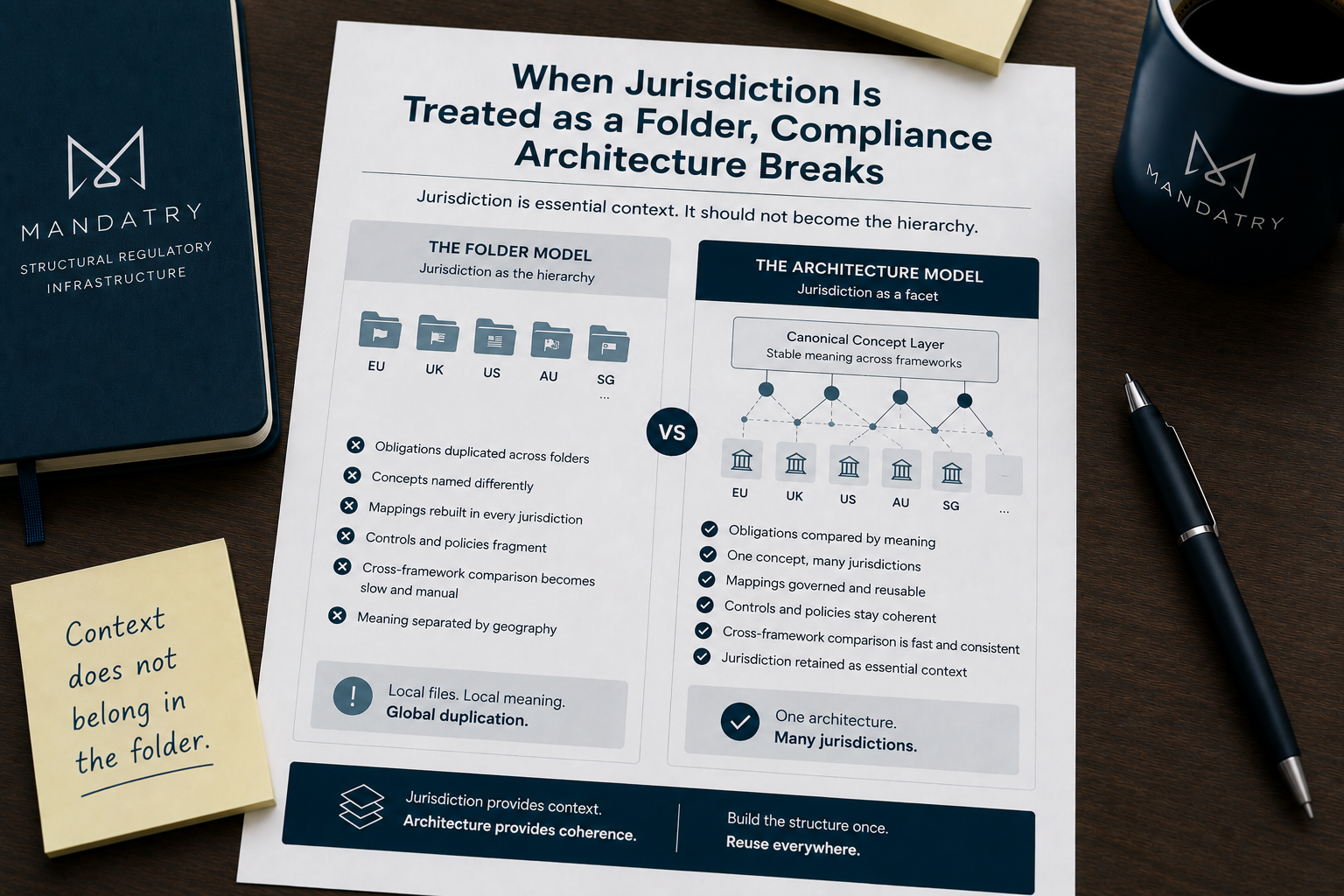
Jurisdiction matters in compliance, but it should not become the organising hierarchy for regulatory architecture. When jurisdiction is treated as a folder, organisations duplicate obligations, fragment concepts and make cross-framework comparison harder than it needs to be.
Jurisdiction matters.
Regulation is issued by authorities, applies within legal systems and is shaped by geography, institutions, market access, supervisory expectations and territorial scope. A privacy requirement in one jurisdiction may not be identical to a privacy requirement in another. A cyber resilience obligation may sit inside a different legal regime. A financial services rule may depend on local supervisory architecture. An AI governance obligation may have different legal consequences depending on where it operates.
So jurisdiction cannot be ignored.
The architectural mistake is different. It happens when organisations treat jurisdiction as the main folder structure for compliance.
Europe. United Kingdom. United States. Australia. Singapore. South Africa. Global. Each folder begins to hold its own frameworks, mappings, controls, interpretations, policy links and evidence expectations.
At first, this feels intuitive. It gives teams a place to put things and allows local experts to manage local requirements. But over time, the folder structure starts to fragment regulatory meaning. Similar obligations are recreated locally. Similar concepts are named differently. Mappings are rebuilt. Controls are duplicated. Policy links diverge. Evidence assumptions multiply.
The organisation has not only separated jurisdictions.
It has separated meaning.
Jurisdiction is essential context, but it should not become the whole organising model for regulatory architecture.
The folder problem
Folders are simple, which is why they are attractive.
A new regulation appears in a jurisdiction, so it goes into the relevant jurisdiction folder. A local team reviews it, maps it, records the interpretation and maintains the tracker. The structure feels practical because each jurisdiction has its own materials, each team can work within its own legal context and each framework has a visible home.
That model can be useful for administration, but it becomes fragile when it is treated as architecture.
The problem is that regulatory meaning does not always respect folder boundaries. A data governance obligation may recur across several jurisdictions. A transparency obligation may appear in privacy, AI, consumer protection and financial services contexts. A record keeping obligation may appear in cyber, operational resilience, sustainability reporting and tax governance.
If each jurisdiction folder develops its own obligation model, the organisation eventually has to compare local structures against each other instead of comparing the obligations themselves.
That is slow, expensive and difficult to govern.
Jurisdiction is a facet
Jurisdiction should behave as a facet of regulatory structure.
A facet describes where a framework, provision or obligation belongs. It gives legal and territorial context. It supports filtering, comparison, source analysis and local review. It helps users understand authority, scope, jurisdictional relevance and the setting in which a requirement appears.
But a facet is not the same as a hierarchy.
When jurisdiction becomes the hierarchy, everything underneath it tends to become locally owned and locally interpreted. That may make sense for legal review, but it does not work well for structural comparison.
The organisation needs to preserve jurisdictional context without letting jurisdiction become a wall around meaning.
A privacy obligation in one jurisdiction should retain its source, authority and local legal context. But it should also be possible to compare that obligation with related obligations in other jurisdictions through a stable structural layer.
That is the difference between filing by jurisdiction and modelling jurisdiction properly.
Obligation patterns cross borders
Many regulatory obligation patterns are not unique to one jurisdiction.
They recur across legal regimes, standards, supervisory expectations and domains. Accountability, transparency, risk assessment, incident reporting, record keeping, access control, third party oversight, governance responsibility, documentation, auditability, data minimisation, user notification, supervisory cooperation and evidence retention all appear in many forms across regulatory systems.
The details may differ. Legal force may differ. The regulator may differ. Timing, thresholds, definitions, evidence expectations and enforcement context may differ. Those differences matter and should not be flattened.
But the structural pattern may still be related.
If an organisation treats each jurisdiction as a separate folder, those relationships become harder to see. The same underlying concept may be recreated many times, each with local wording, local assumptions and local mappings.
That creates repeated work. More importantly, it weakens the organisation's ability to understand how its regulatory estate fits together.
Why jurisdiction folders weaken comparison
Cross-jurisdiction comparison depends on stable structure.
If every jurisdiction has its own obligation model, comparison becomes a manual reconciliation exercise. Teams have to ask whether one local requirement matches another, whether a concept is the same as the concept used elsewhere, whether a control covers both obligations, whether a mapping is reusable and whether a difference is substantive or only linguistic.
These questions are difficult even when the structure is coherent. They become much harder when each jurisdiction has developed a parallel model.
The organisation ends up comparing folders rather than regulatory meaning.
That is fragile because the folder structure may reflect where a requirement came from, but not what the requirement means structurally or how it relates to other obligations.
It also makes change harder to interpret. If one jurisdiction changes a requirement, the organisation may not know which related obligations in other jurisdictions should be reviewed because the relationships between those obligations were never normalised.
The illusion of local completeness
A jurisdiction folder can look complete.
It may contain the relevant frameworks, local mappings, control references, policy notes, evidence expectations and implementation records. For the local team, that can be useful and necessary.
But local completeness can hide enterprise fragmentation.
Each jurisdiction may look organised in isolation, while the organisation as a whole lacks a coherent regulatory architecture. A global compliance leader may ask how obligations compare across jurisdictions, only to discover that every folder uses different language, different mapping assumptions and different control relationships.
The problem is not that local teams have done poor work. In many cases, the local work is careful and well informed. The problem is that the operating model encouraged local structure instead of shared structure.
The organisation becomes covered jurisdiction by jurisdiction, but not coherent across jurisdictions.
Domain and jurisdiction are different things
Another source of confusion is the relationship between domain and jurisdiction.
A domain is a regulatory or governance area, such as privacy and data protection, digital trust, AI governance, operational resilience, sustainability governance, financial services and insurance governance, or tax, finance and corporate reporting.
Jurisdiction tells the organisation where the framework sits legally or territorially. Domain tells the organisation what structural regulatory area the framework belongs to.
Those are different dimensions.
When jurisdiction becomes the top-level hierarchy, domain coherence can disappear. Privacy obligations in one jurisdiction sit far away from privacy obligations in another. Cyber obligations are split across country folders. AI governance is treated locally even where its concepts overlap with broader governance, data, product and risk structures.
The organisation loses the ability to see domain patterns across jurisdictions.
That is why jurisdiction should be used as a facet of the architecture, not as the architecture itself.
Sector is different again
Sector creates another layer of potential confusion.
A framework may be relevant to financial services, healthcare, technology, public sector, energy, telecommunications or other regulated industries. That sector context matters because obligations may be shaped by market structure, supervisory focus and industry-specific expectations.
But sector is not the same as jurisdiction, and it is not the same as domain.
A sector tag helps describe market or industry relevance. It should not replace the structural classification of the framework, and it should not become the primary way of modelling regulatory meaning.
If jurisdiction becomes a folder and sector becomes a sub-folder, the architecture can fragment even further. A cyber obligation in financial services may be separated from similar cyber obligations in critical infrastructure. A privacy obligation in healthcare may be separated from similar privacy obligations in technology. An AI governance obligation in financial services may be separated from similar AI governance obligations in employment or consumer protection.
The organisation gains local filing logic, but loses structural comparison.
Legal context still matters
Treating jurisdiction as a facet does not mean treating jurisdiction as unimportant.
The opposite is true.
Jurisdictional context should be preserved carefully. A framework should retain its jurisdiction. A provision should retain its source. A legal obligation should not be stripped of its authority, territorial context, legal force or local implementation history.
The point is that preserving context is not the same as making jurisdiction the organising hierarchy for every structural decision.
The architecture needs to hold two truths at once. Jurisdiction matters, and regulatory meaning often crosses jurisdictional boundaries.
The goal is not to flatten legal differences. It is to prevent legal context from becoming structural fragmentation.
That requires a model that can preserve local legal meaning while still allowing related obligations and concepts to be compared across the wider regulatory estate.
What breaks without a canonical layer
When jurisdiction folders operate without a canonical layer, several things start to break over time.
Concepts duplicate. Mappings diverge. Synonyms accumulate. Controls are linked inconsistently. Framework comparisons become slow. Change analysis becomes local. Global reporting becomes harder. Enterprise architecture becomes less reusable.
Each new jurisdiction increases the amount of work because the organisation lacks a shared model for what can be reused and what must remain distinct.
This creates a scaling problem. Expansion into a new jurisdiction brings not only new regulation, but another local interpretation layer. The organisation becomes more covered, but less coherent.
Without a canonical layer, jurisdictional growth becomes structural multiplication.
The role of canonical concepts
Canonical concepts help solve the folder problem.
They provide a stable structural layer beneath jurisdictional context. A canonical concept does not erase jurisdictional difference. It gives the organisation a governed way to identify recurring regulatory meaning across frameworks, standards and jurisdictions.
This allows the organisation to ask better questions.
Which concepts recur across jurisdictions? Which obligations are structurally similar? Which requirements are jurisdiction-specific? Which obligations partially overlap? Which mappings need review? Which framework adds genuinely new structure? Which local terms are synonyms, and which should remain distinct?
These questions change jurisdiction from a wall into a lens.
The organisation can still filter by jurisdiction, but it can also compare across jurisdictions. It can preserve the source context while seeing the broader structure.
That is the architectural shift.
The risk of regional copies
Many enterprises manage cross-jurisdiction compliance by copying structures from one region to another.
A control set is adapted. A policy is localised. A mapping is reused. A spreadsheet is duplicated. A framework assessment is repurposed.
This can be efficient in the short term, especially when teams are working under pressure. But without structural governance, copied materials create uncertainty.
The copied control may not match the local obligation. The local wording may imply a different concept boundary. A requirement may be broader or narrower than the original. A mapping may appear reusable when it only partially overlaps. A local team may alter the structure without feeding that change back into the enterprise model.
The organisation thinks it is scaling. In reality, it may be copying interpretation.
A structural layer helps distinguish what can be reused from what must be reviewed locally. That distinction is essential for global compliance maturity.
Why this matters for global enterprises
Global enterprises need both local precision and enterprise coherence.
They need to respect jurisdictional difference, but they also need to avoid rebuilding the same regulatory model in every market. That balance is difficult.
If everything is centralised too aggressively, local nuance may be lost. If everything is localised too heavily, enterprise coherence disappears.
A structural layer helps manage that tension. It allows obligations to be represented with source context, jurisdictional metadata and legal force while still connecting related concepts across the wider regulatory estate.
That is the difference between global filing and global architecture.
Global filing organises documents by place. Global architecture preserves place as context while still allowing meaning to be compared.
Architecture makes jurisdiction more useful
When jurisdiction is treated as a facet, it becomes more useful, not less.
Users can filter by jurisdiction, compare jurisdictions, identify frameworks within a region, see where a jurisdiction introduces net-new structure and understand how local obligations relate to wider patterns.
Local teams can still work with local context. Enterprise teams can still compare across markets. Controls, policies and reports can connect to jurisdictional detail without being trapped inside isolated folders.
The jurisdictional view becomes one way to interrogate the architecture. It is not the architecture itself.
That is a more flexible model because it supports local work and enterprise comparison at the same time.
What Mandatry is doing
Mandatry treats jurisdiction as an important facet of regulatory structure, not as the primary hierarchy.
It decomposes regulatory frameworks into atomic obligations and aligns them through a governed canonical model. That allows frameworks from different jurisdictions to be compared through structural concepts rather than only through local folders, documents or control mappings.
Mandatry does not provide legal advice. It does not determine whether a customer is in scope. It does not flatten jurisdictional differences into generic statements. It does not certify compliance, score readiness, assign remediation tasks or replace legal, regulatory, risk or compliance teams.
Its role is different.
Mandatry helps make cross-jurisdiction regulatory architecture structurally coherent. That means preserving jurisdictional context while enabling obligations, concepts and mappings to be normalised across the wider compliance estate.
Jurisdiction remains visible.
It simply stops being the wall that prevents comparison.
Jurisdiction is a facet, not the architecture
Jurisdiction is essential, but when jurisdiction becomes the main folder structure for compliance architecture, meaning fragments.
The same obligation patterns are recreated locally. Concepts drift. Mappings diverge. Controls are linked inconsistently. Global comparison becomes harder.
The answer is not to ignore jurisdiction. The answer is to model it properly.
Jurisdiction should be a facet that enriches regulatory structure, not a wall that prevents structure from being compared.
For regulated enterprises, that distinction is critical. Global compliance maturity is not achieved by building more jurisdiction folders. It is achieved by building a coherent regulatory architecture that can hold jurisdictional context without being trapped by it.
That is what Structural Regulatory Infrastructure makes possible.
Explore Structural Regulatory Infrastructure
See how Mandatry makes regulatory frameworks structurally comparable through atomic obligations and canonical concepts.