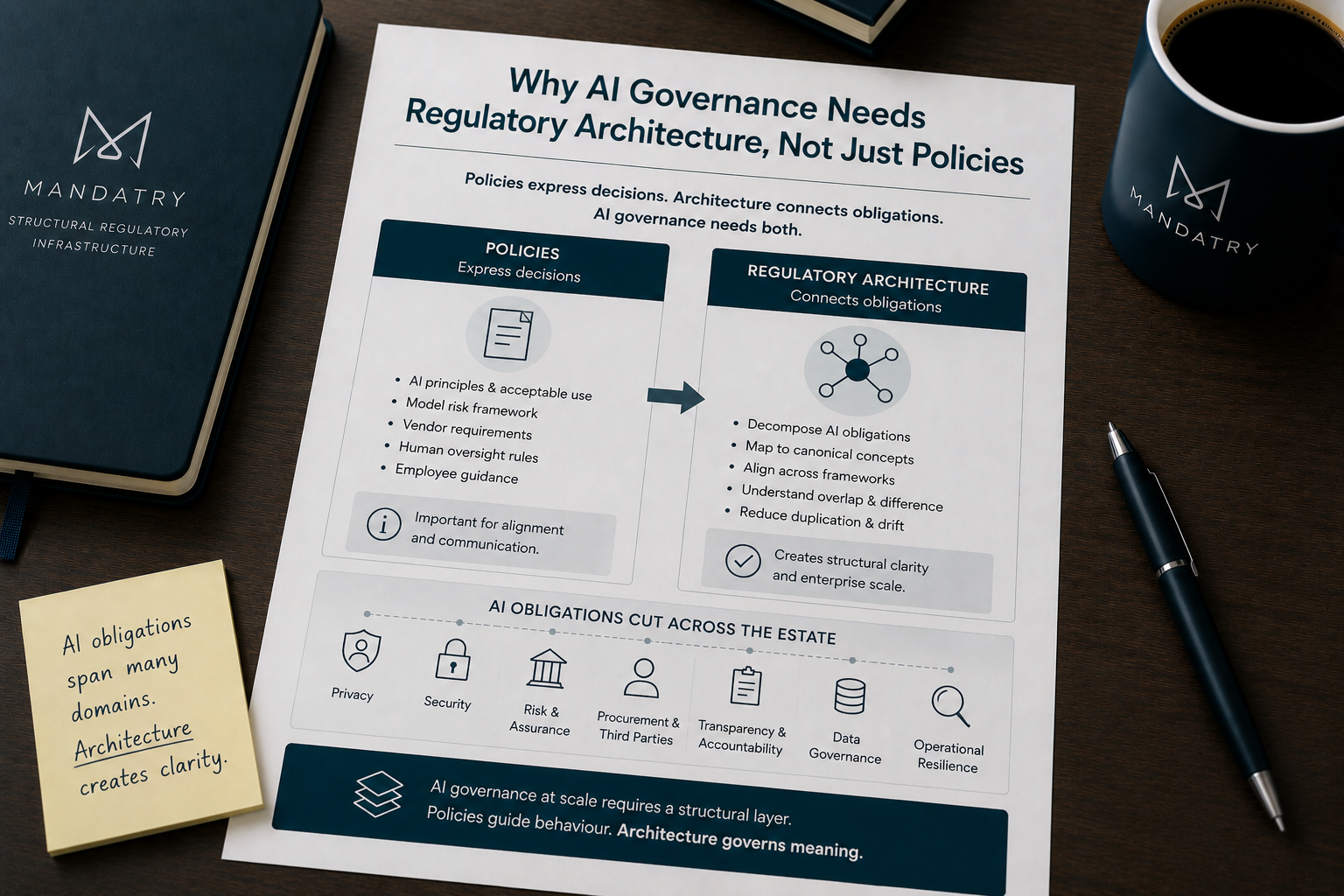
Why AI Governance Needs Regulatory Architecture, Not Just Policies
AI governance cannot be managed through policies alone. As AI obligations expand across transparency, risk management, oversight, accountability, data governance and third party use, enterprises need a structural layer that shows how those obligations relate across frameworks and systems.
AI governance is often treated as a policy problem.
Organisations draft acceptable use policies, create AI principles, issue guidance to employees, define approval processes and set rules for procurement, deployment, transparency, human oversight and risk review. Those policies matter. They help organisations communicate expectations, create internal boundaries and make AI governance visible.
But AI governance cannot be managed through policies alone.
The challenge is becoming structural. AI obligations now touch privacy, cyber security, procurement, product governance, model risk, transparency, accountability, documentation, third party oversight, data quality, human review and record keeping. Those obligations do not sit neatly inside one policy, one register, one committee or one workflow.
They cut across several functions, frameworks and regulatory regimes.
Without regulatory architecture beneath the policy layer, AI governance quickly becomes a collection of documents, committees, registers and local interpretations. The organisation may appear active, but the structure beneath that activity may remain fragmented.
That is not enough for enterprise scale.
Policies express decisions
Policies are important because they express decisions.
They tell people what the organisation expects, define internal rules, set behavioural boundaries, support training and help teams align around acceptable use. A good AI policy may explain when employees can use AI tools, what information must not be entered, how AI outputs should be reviewed, how vendors should be assessed and when escalation is required.
That is useful governance work.
But a policy is not the same as regulatory structure.
A policy tells the organisation how it has chosen to govern. Regulatory architecture explains the obligations, concepts and mappings that sit beneath those choices. It shows which source requirements are being represented, how those requirements relate to existing frameworks, where concepts recur and where the organisation has made structural interpretation decisions.
If that structure is unclear, the policy layer becomes fragile.
A policy may contain the right themes, but the organisation may still struggle to explain how those themes connect to the wider regulatory estate. It may know that transparency, oversight, documentation and third party review matter, but not whether those concepts have already been represented elsewhere, whether the relevant obligations overlap, or which mappings should be treated as authoritative.
That is the difference between having AI governance documents and having AI regulatory architecture.
AI governance crosses existing domains
AI governance does not arrive as a completely separate universe.
It overlaps with areas enterprises already govern: privacy, cyber security, operational resilience, consumer protection, employment, procurement, financial services governance, product safety, third party risk, assurance, records and auditability.
AI-specific obligations may introduce new requirements, but they also reuse familiar governance patterns. Transparency, accountability, risk assessment, human oversight, documentation, security, data governance, incident handling, monitoring and vendor management all appear in other regulatory contexts.
This matters because organisations should not treat every AI obligation as if it has no history.
Some AI requirements may be genuinely new. Some may be new expressions of familiar obligations. Some may partially overlap with existing privacy, cyber, procurement or risk governance structures. Some may require careful review before they can be aligned with anything already present.
The challenge is not simply to write an AI policy.
The challenge is to understand how AI obligations relate to the broader regulatory estate. Policies can express the organisation's response, but they cannot by themselves normalise the relationship between AI obligations and the structures that already exist elsewhere in the compliance stack.
The policy layer can hide duplication
When organisations respond to AI governance through policies alone, duplication appears quickly.
One team creates an AI acceptable use policy. Another creates a model risk framework. A privacy team updates data protection procedures. Procurement adds AI questions to vendor due diligence. Security updates cyber guidance. Compliance creates a register. Risk teams build an approval process. Training teams produce internal guidance. Legal teams review contractual terms. Control owners begin mapping AI obligations into existing frameworks.
Each activity may be sensible on its own.
The problem is that, without a shared structural layer, the organisation may not know whether these activities are responding to the same obligation patterns or genuinely different requirements.
Transparency may be defined differently across teams. Human oversight may mean different things in different contexts. Documentation obligations may be repeated across policies. Risk assessment language may drift. Third party AI governance may be split across procurement, privacy, security and legal without a common model.
The organisation appears active, but activity is not architecture.
A policy programme can create visible governance while still allowing the underlying obligation structure to fragment.
AI makes meaning unstable
AI governance introduces new terminology quickly.
Organisations encounter terms such as provider, deployer, operator, model, system, intended purpose, high risk, general purpose AI, transparency, synthetic content, human oversight, technical documentation and post-market monitoring.
Some terms have specific legal meanings in particular frameworks. Some are used more loosely in internal policy. Some overlap with older governance language from privacy, cyber security, operational risk, procurement or product governance.
This creates a meaning problem.
If terms are not governed, different teams build different interpretations into their own processes. A privacy team may read transparency one way. A product team may read it another. A cyber team may focus on technical safeguards. A legal team may focus on regulatory wording. An operational risk team may focus on governance committees, escalation and accountability.
All of those perspectives may be valid, but they need a shared structural model.
Otherwise, AI governance becomes a vocabulary problem disguised as a policy programme. Teams use familiar words, but the architecture beneath those words is inconsistent.
That inconsistency becomes harder to manage as AI adoption expands.
Registers are not architecture either
Many organisations also respond to AI governance by creating inventories and registers.
They may build AI use case registers, model inventories, vendor lists, risk assessments, approval logs and exception trackers. These are useful governance artefacts. They help organisations understand where AI is being used, who owns a use case, which vendor is involved, what review has taken place and which items may need escalation.
But registers are not the same as regulatory architecture.
A register can show which AI systems exist. It can record owners, purposes, vendors, risk ratings, review dates and approval status. What it may not show is how the organisation's AI obligations relate across frameworks.
It may not show whether a transparency requirement overlaps with a privacy notice obligation. It may not show whether documentation requirements recur across AI governance, cyber security and procurement. It may not show whether third party obligations are structurally similar to existing vendor governance requirements. It may not distinguish new AI-specific structure from familiar governance patterns.
A register helps track objects. Architecture helps govern meaning.
Both are useful, but they solve different problems.
Why obligations need decomposition
AI regulation often bundles several obligations together.
A single article, rule, policy statement or guidance section may contain requirements about transparency, technical documentation, data governance, human oversight, accuracy, security, monitoring, user communication or post-deployment review. For operational teams, those requirements need to be understood at a more precise level.
The organisation needs to know which obligation concerns disclosure, which concerns oversight, which concerns documentation, which concerns data, which concerns risk assessment, which concerns vendor governance and which concerns post-deployment review.
Without decomposition, AI governance remains too coarse.
Policies may refer to broad requirements, but teams struggle to understand the specific obligation structure beneath them. This creates confusion when mapping controls, updating procedures, reviewing vendors, collecting evidence or comparing AI requirements with existing governance frameworks.
Atomic obligation modelling makes the structure clearer.
It allows the organisation to preserve the source requirement while representing it in a form that can be compared, mapped and governed across the wider compliance architecture.
AI governance needs canonical concepts
Once obligations are decomposed, they need to be aligned. That is where canonical concepts matter.
A canonical concept gives the organisation a stable way to represent recurring regulatory meaning across different frameworks and domains. For AI governance, this is especially important because many obligations are not isolated to AI.
Data quality may connect to privacy and data governance. Security may connect to cyber frameworks.
Transparency may connect to consumer protection and data protection. Human oversight may connect to accountability and risk management. Third party AI use may connect to procurement and vendor governance. Documentation may connect to auditability and assurance.
A canonical concept layer helps organisations see those relationships.
It does not collapse all obligations into one general idea. It does not pretend that every use of transparency, oversight or risk management means the same thing in every context. Instead, it creates a governed way to distinguish similarity, partial overlap and genuine difference.
That is what policies alone cannot do.
Policies may use the language of AI governance. Canonical concepts help the organisation understand how that language relates to the rest of the regulatory estate.
The risk of building AI governance as a silo
AI governance is new enough that many organisations are tempted to build it as a separate programme.
A separate policy. A separate committee. A separate register. A separate risk process. A separate review workflow.
Some separation may be necessary, especially where AI-specific expertise is required. Organisations may need dedicated governance forums, specialist review and clear ownership for AI-related decisions.
But if AI governance becomes structurally isolated, the organisation risks duplicating what already exists elsewhere.
It may recreate privacy governance, cyber assurance, vendor risk processes, model risk controls, documentation standards and accountability structures under AI-specific labels. It may build new workflows without understanding how those workflows relate to obligations and controls already present in other parts of the organisation.
The better question is not whether AI governance needs its own programme. It is how AI obligations fit into the regulatory architecture the organisation already has.
That distinction prevents AI governance from becoming another isolated operating model.
Why this matters for enterprise scale
Small organisations may be able to manage early AI governance through a few policies, manual reviews and centralised decisions.
Large organisations cannot rely on that model for long.
They may have many AI use cases, many vendors, many business units, many jurisdictions, many regulators and many existing control environments. They may also have different levels of AI maturity across teams, products and markets.
At that scale, local interpretation becomes expensive.
One business unit interprets transparency one way. Another interprets human oversight differently. A third treats vendor AI use as procurement risk. A fourth treats it as data protection risk. A fifth treats it as operational resilience risk.
Each interpretation may make sense locally. But if those interpretations are not connected through a structural layer, the enterprise does not have one AI governance architecture.
It has multiple local governance models using similar words in different ways.
That is not sustainable.
Architecture comes before automation
AI governance is also vulnerable to premature automation.
Organisations want tools to classify systems, populate registers, generate policy language, monitor use, flag risks and produce documentation. Those tools may help, especially when AI use is expanding quickly and governance teams need more visibility.
But automation built on weak structure can scale confusion.
If obligations are not decomposed, automation may process broad requirements too crudely. If concepts are not governed, automation may treat similar wording as equivalent when it is not. If mappings are not reviewable, automation may create confidence without enough traceability. If controls are mapped before obligations are understood, automation may reinforce the wrong relationships.
The sequence matters. Architecture comes before automation.
A governed structural layer makes downstream AI governance tooling more dependable because it gives those tools a clearer model to work from. Without that layer, automation may make fragmented governance faster rather than more coherent.
AI governance needs change memory
AI governance will not be a one-time project.
Regulatory expectations will evolve. Standards will mature. Guidance will be refined. Internal AI use will expand. Vendors will change. Models will be updated. Use cases will move from experimentation to production. Controls and policies will need review.
That means organisations need change memory.
They need to remember why a use case was classified in a particular way, why a transparency decision was made, why a vendor was treated as relevant, why a mapping was accepted, why a control was linked to an AI obligation and why a concept boundary changed.
Without that memory, AI governance becomes difficult to maintain. Teams revisit old decisions, reinterpret familiar obligations, duplicate evidence requests and struggle to explain why the structure looks the way it does.
A designed regulatory architecture preserves decisions over time. It allows organisations to update AI governance without losing the rationale behind earlier structural choices.
What AI governance teams should ask
AI governance teams should not only ask whether a policy exists.
They should ask structural questions.
Which obligations are AI-specific? Which obligations reuse existing governance patterns? Which concepts already exist elsewhere in the regulatory estate? Which requirements overlap with privacy, cyber, operational risk or procurement? Which mappings are authoritative? Which terms need controlled definitions? Which obligations are genuinely net new? Which areas require human review before alignment can be trusted? Which downstream systems depend on this structure?
These questions move AI governance beyond documentation.
They help teams understand the regulatory architecture beneath policies, registers, controls and workflows. They also help preserve an important boundary: structural analysis does not replace legal interpretation or operational decision-making. It gives those teams a more coherent substrate.
That is what enterprise AI governance needs as the obligation landscape expands.
What Mandatry is doing
Mandatry is built for the structural layer beneath compliance operations.
It decomposes regulatory frameworks into atomic obligations and aligns them through a governed canonical model. For AI governance, that means helping organisations understand how AI obligations relate to wider regulatory architecture, including privacy, digital trust, operational resilience, assurance, sector conduct and governance expectations.
Mandatry does not provide legal advice. It does not determine whether an organisation is in scope. It does not certify AI compliance. It does not score readiness. It does not assign remediation tasks. It does not replace legal, risk, compliance, privacy, security or AI governance teams.
Its role is different.
Mandatry helps make the regulatory structure beneath those teams more coherent. That is especially important for AI governance because the obligation landscape is expanding across multiple domains at once.
AI governance needs policies, registers, controls and oversight. Mandatry provides the structural regulatory layer those surfaces can depend on.
AI governance needs architecture, not just policies
AI governance needs policies, but policies are not enough.
Policies express decisions. Registers track use cases. Committees create oversight. Controls support execution. Those layers matter, but they do not replace regulatory architecture.
Regulatory architecture explains how the obligations beneath those activities relate to one another.
Without that architecture, AI governance fragments quickly. The same concepts are defined repeatedly. The same obligations are mapped in different places. The same evidence expectations appear across several processes. The same governance patterns are rebuilt under AI-specific labels.
The next stage of AI governance maturity is not simply more policies.
It is a coherent structural layer beneath those policies.
Because AI governance is not only a policy management problem. It is a regulatory architecture problem.
And that is exactly where Structural Regulatory Infrastructure matters.
Explore Structural Regulatory Infrastructure
See how Mandatry makes regulatory frameworks structurally comparable through atomic obligations and canonical concepts.