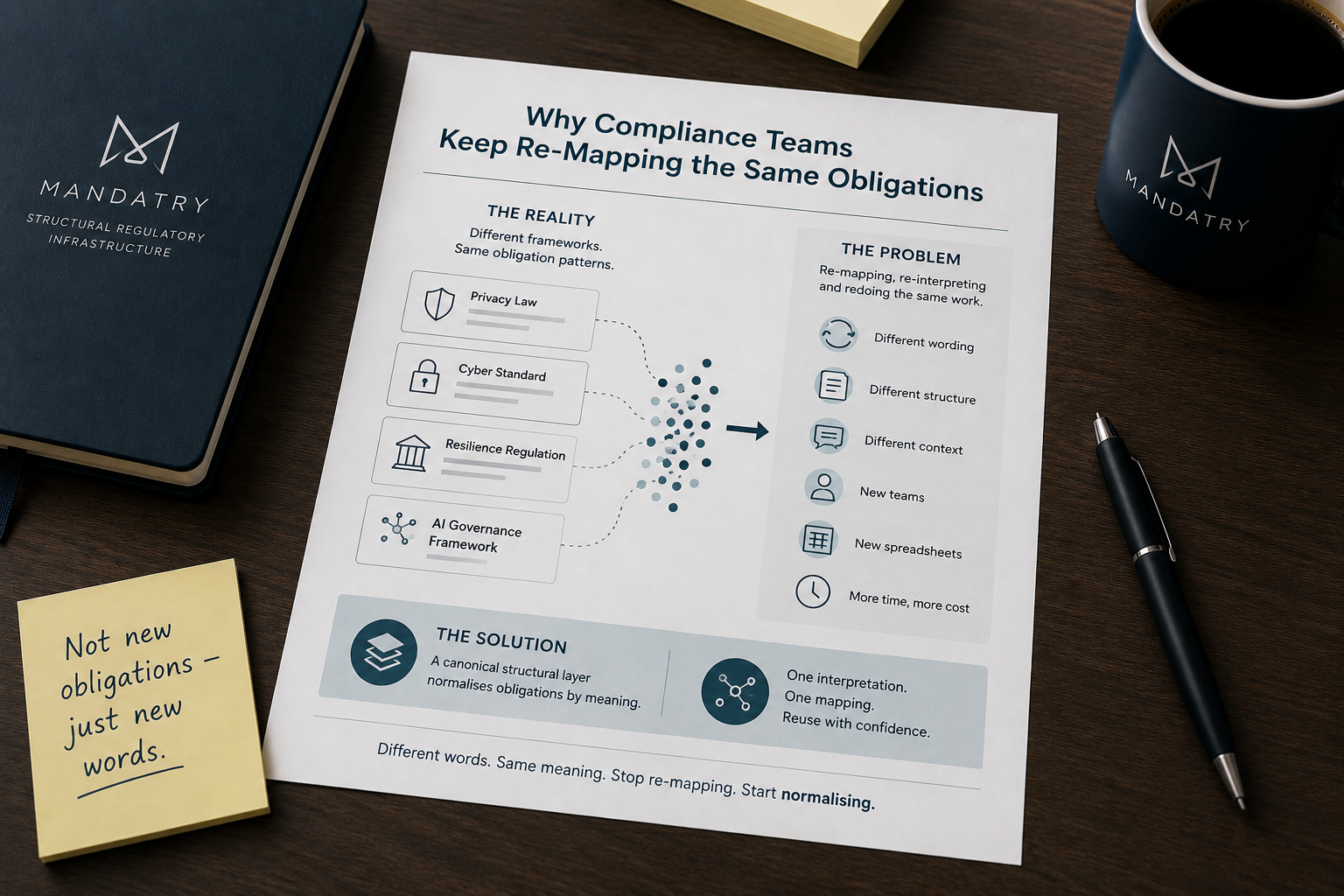
Why Compliance Teams Keep Re-Mapping the Same Obligations
Compliance teams often repeat the same mapping work each time a new framework, regulation or standard enters scope. The wording changes, but many obligation patterns recur. Without a canonical structural layer, organisations keep re-mapping what they have already interpreted before.
Every time a new framework enters scope, a familiar process begins.
Teams review the text, identify obligations, compare them with existing controls, align them to policies, prepare evidence expectations and decide how the new framework relates to what the organisation already does. The work is careful, necessary and often highly skilled.
Then another framework arrives, and much of the process starts again.
The terminology may be different. The numbering may be different. The headings, definitions and structure may be different. But beneath those surface differences, many of the same obligation patterns often return.
This is one of the least visible sources of compliance cost. Organisations do not only spend time responding to new regulation. They spend time re-interpreting regulatory structure they have already encountered before.
The work repeats because the underlying meaning has not been normalised.
The problem is not lack of discipline
Compliance teams do not re-map obligations because they are careless. They do it because most compliance environments are organised around frameworks, documents, controls, systems and projects, rather than around a stable model of regulatory meaning.
A privacy law is treated as one body of work. A cyber standard becomes another. An operational resilience regime becomes another. An AI governance framework becomes another. A sustainability reporting standard becomes another.
Each framework arrives with its own vocabulary and structure. Each may be reviewed by different stakeholders, mapped into different tools and supported by different spreadsheets, policy references or advisory outputs.
That way of working is understandable. New frameworks often need dedicated attention, especially when they carry their own legal context, supervisory expectations or market pressure.
The problem is that the organisation begins to treat each new framework as if it is structurally new, even when parts of it describe familiar obligations.
That creates repeated effort. More importantly, it creates repeated interpretation.
Repetition hides inside different wording
Regulatory language changes from framework to framework.
One framework may refer to accountability. Another may refer to governance oversight. Another may refer to responsibility allocation. Another may refer to management ownership.
Those phrases are not automatically identical. The legal context, scope, trigger, evidence expectation and supervisory purpose may differ. But the underlying obligation may still be structurally related.
The same pattern appears across many recurring regulatory themes: transparency, record keeping, access control, risk assessment, incident reporting, third party oversight, auditability, training, control monitoring and policy maintenance.
These patterns appear across privacy, cyber, AI governance, sustainability, financial services, operational resilience and other regulated domains. They should not be collapsed casually, because expert review still matters and difference must be preserved.
But without a canonical structural layer, teams have no stable way to separate true novelty from recurring obligation structure.
So they re-map.
They revisit familiar ideas under new labels. They compare wording manually. They recreate mapping logic in another spreadsheet. They debate whether a requirement is new because the language has changed, even when the underlying concept may already exist elsewhere in the regulatory estate.
Why control libraries do not fully solve this
Control libraries are important, but they do not automatically solve obligation duplication.
A control is usually an operational response. An obligation is the regulatory requirement or expectation being responded to. That distinction matters because multiple obligations may map to one control, one obligation may require several controls, and two frameworks may use different language while pointing towards a similar operational response.
A control library can help rationalise activity. It can show where existing controls support several requirements, where evidence can be reused and where operational duplication may be reduced.
But a control library does not necessarily explain how regulatory obligations relate to each other structurally.
This is why organisations can have a large control library and still keep re-mapping obligations. The controls may be consolidated, but the regulatory meaning beneath them remains fragmented.
Teams still need to ask whether they have seen an obligation before, whether the requirement is structurally equivalent or only partially overlapping, which canonical concept it belongs to, which previous mappings can be reused and which earlier interpretations should be challenged.
Without answers to those questions, every new framework creates another round of manual reconciliation.
Why spreadsheets persist
Spreadsheets persist because they are flexible. They let teams compare frameworks, add notes, create mappings, resolve ambiguity and move quickly.
That flexibility is useful, especially during early analysis. But spreadsheets also make structural repetition easy to hide.
A team can create another column, another tab, another crosswalk and another local interpretation. At the project level, this may look efficient. At enterprise level, it becomes fragile.
The same obligation may be mapped differently in different spreadsheets. A synonym may be treated as a new concept. A partial overlap may be recorded as full alignment. A historical mapping may survive long after the underlying interpretation has changed.
The spreadsheet does not enforce structural coherence. It records the latest local decision.
That may be enough for a project. It is not enough for regulatory infrastructure.
The hidden cost of starting from text every time
When organisations lack a governed obligation structure, they often start from source text each time. That creates several kinds of cost.
There is the cost of reading and interpretation, as teams review the framework, extract obligations, identify themes and decide what matters.
There is the cost of comparison, as teams ask whether the new framework overlaps with existing frameworks, controls, policies and evidence.
There is the cost of reconciliation, as different teams discover that similar obligations may already have been mapped elsewhere, but in different language or with different assumptions.
There is the cost of governance, because someone eventually needs to decide which interpretation is authoritative.
Finally, there is the cost of maintenance. When the framework changes, the organisation needs to understand what has structurally changed, not merely which words or sections have been updated.
These costs compound. They may not be visible in a single project budget, but they accumulate across every framework, jurisdiction and business unit.
The same work keeps returning
The recurring nature of compliance work is easy to underestimate.
A team may map data protection obligations for one jurisdiction, then encounter related obligations in another. A cyber team may map access control requirements under one standard, then meet similar requirements in another. A sustainability team may map reporting obligations across multiple disclosure regimes. An AI governance team may map transparency, oversight and risk management obligations that resemble patterns already present in privacy, cyber and operational resilience.
Each domain has its own substance. Each framework deserves careful review.
But the organisation should not have to rebuild the structural foundation every time.
Once an obligation pattern has been identified, normalised and governed, it should become part of a reusable reference layer. That does not mean every future obligation is automatically treated as identical. It means future obligations can be compared against a stable baseline, rather than rediscovered from scratch.
That is the point of regulatory architecture.
What a canonical layer changes
A canonical layer gives the organisation a stable way to represent recurring regulatory meaning.
Instead of treating each framework as an isolated body of text, the organisation decomposes frameworks into atomic obligations and aligns them through governed canonical concepts. The focus shifts from asking only what the framework says to also asking how the framework fits into the architecture that already exists.
That changes the quality of the mapping exercise.
Teams can identify which obligations are already represented, which concepts the framework reuses, which obligations partially overlap with existing obligations, which requirements are structurally net new, which mappings require human review and which previous interpretations are being reused.
This does not remove judgement. It makes judgement reusable.
A decision made once can be governed, reviewed and reused rather than rediscovered in every project. A partial overlap can remain visible as partial. A disputed mapping can be reviewed. A concept boundary can be refined. A previous interpretation can be challenged rather than silently repeated.
That is a different operating model from one-off mapping.
Why this matters for new frameworks
New frameworks often feel completely new because their packaging is new.
They may introduce new headings, definitions, obligations and enforcement context. They may sit within a different regulatory domain or apply to a different organisational function. They may also arrive with urgency, which encourages teams to mobilise around the framework as a standalone programme.
But not everything inside a new framework is structurally new.
Some requirements may be extensions of familiar governance patterns. Some may be domain-specific versions of obligations already seen elsewhere. Some may be genuinely new. Some may be ambiguous and require review.
The value of a structural layer is that it helps separate those categories.
Without that layer, organisations tend to respond to each new framework as a large undifferentiated block. That makes implementation heavier than it needs to be. It also makes comparison harder, because the organisation lacks a stable model for understanding how new material relates to the existing baseline.
A new framework should not always mean a new interpretation universe.
Re-mapping is a governance problem
Re-mapping is not only an efficiency problem. It is a governance problem.
If different teams repeatedly interpret similar obligations in different ways, the organisation loses structural control over its regulatory estate. Mappings become inconsistent. Concept boundaries drift. Terminology fragments. Control alignment becomes harder to defend. Change analysis becomes less reliable.
The organisation may still appear mature because it has many frameworks, controls and documented mappings. But beneath that surface, it may be operating on accumulated local interpretations.
That is fragile.
A mature compliance architecture needs more than documentation. It needs governed meaning. It needs to preserve the difference between a local mapping decision and an authoritative structural relationship. It needs to know which concepts are stable, which mappings are accepted, which require review and which previous assumptions should no longer be carried forward.
Without that governance, re-mapping becomes a permanent feature of the compliance operating model.
Mapping should become structural
The answer is not to stop mapping. Mapping remains essential because organisations need to understand how obligations relate to frameworks, controls, policies, evidence, functions and systems.
The answer is to make mapping structural.
A structural mapping approach does not treat each new framework as a blank page. It starts from the regulatory architecture already built. It asks whether the incoming obligation is new, recurring, overlapping, narrower, broader, uncertain or dependent on context.
It also separates different kinds of relationships. A control relationship is not the same as an obligation relationship. A policy reference is not the same as a canonical concept. A jurisdictional difference is not the same as a new regulatory idea. A wording difference is not always a meaning difference.
This discipline makes mappings more reviewable and more durable. It also makes them easier to maintain when frameworks change.
What Mandatry is doing
Mandatry is designed to address this structural repetition.
It decomposes regulatory frameworks into atomic obligations and aligns them through a governed canonical model. That allows recurring obligation patterns to be represented once, governed carefully and reused across frameworks.
Mandatry does not replace GRC systems, monitoring tools, policy repositories, control libraries, legal teams or advisory work. It does not provide legal advice, assign remediation tasks, certify compliance, score readiness or determine customer applicability.
Its role is different.
Mandatry sits beneath those systems as Structural Regulatory Infrastructure. It helps make the regulatory structure those systems depend on more coherent, so organisations can understand where obligations recur, where terminology differs but structure overlaps, where an incoming framework adds new obligations, where mappings are shared, where review is required and where regulatory meaning needs governance.
This is structural regulatory normalisation.
It is not legal advice. It is not compliance scoring. It is not certification. It is not workflow management.
It is the normalisation layer beneath the compliance stack.
From repeated mapping to reusable structure
Compliance teams keep re-mapping the same obligations because most organisations do not have a governed structural layer beneath their compliance stack.
They have frameworks, controls, policies, spreadsheets, monitoring tools and advisory outputs. What they often lack is a canonical model that allows regulatory meaning to be reused consistently across frameworks, jurisdictions and standards.
That is why similar obligations keep being rediscovered. It is why mappings multiply. It is why interpretation drifts. It is why compliance work becomes more expensive as the regulatory estate grows.
The next stage of compliance maturity is not to stop mapping. It is to make mapping more structural.
Once obligations are decomposed, normalised and governed through canonical concepts, organisations can stop treating every framework as a blank page. They can build on the regulatory architecture they already have.
That is the difference between repeated compliance projects and Structural Regulatory Infrastructure.
Explore Structural Regulatory Infrastructure
See how Mandatry makes regulatory frameworks structurally comparable through atomic obligations and canonical concepts.