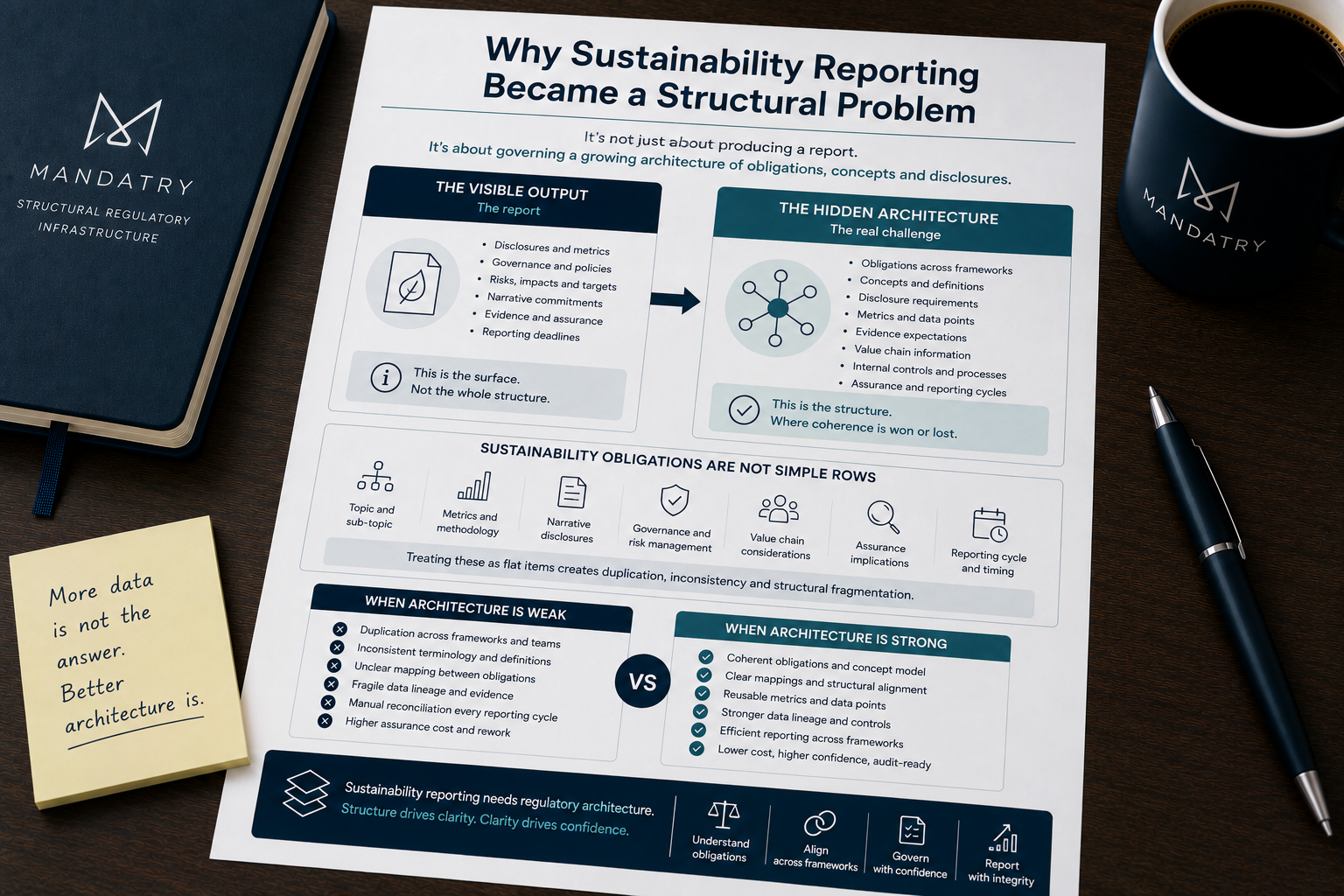
Why Sustainability Reporting Became a Structural Problem
Sustainability reporting is often treated as a disclosure or data collection problem. But as reporting obligations expand across standards, jurisdictions, assurance expectations and value chains, the deeper challenge is structural: how the organisation represents, maps and governs sustainability obligations over time.
Sustainability reporting is often treated as a disclosure problem.
That is understandable. The visible work is the report: what needs to be disclosed, which datapoints are required, who owns the information, which systems hold the data, which statements need evidence, which disclosures require review and which reporting deadline applies.
Those questions matter. Sustainability reporting depends on data, ownership, governance, auditability and process discipline. Without those foundations, organisations struggle to produce reporting that is complete, consistent and supportable.
But the deeper problem is structural.
Sustainability reporting is no longer only about producing a report. It is about governing a growing architecture of obligations, concepts, standards, disclosures, evidence expectations, metrics, value chain information, internal controls, assurance expectations and reporting cycles.
That architecture does not manage itself.
Without a structural layer beneath the reporting process, organisations can collect more data while still lacking coherence in how sustainability obligations are understood, mapped and maintained over time.
Reporting is the visible output
The report is what people see.
It is the published statement. It contains disclosures, metrics, explanations, policies, risks, impacts, governance descriptions, targets, methodologies and narrative commitments. Because the report is visible, it naturally becomes the centre of attention. Teams focus on producing it. Advisers review it. Assurance providers examine it. Investors read it. Regulators may scrutinise it.
But the report is only the final surface.
Behind it sits a much larger structure. Frameworks need to be interpreted. Disclosure requirements need to be decomposed. Topics need to be classified. Datapoints need to be connected to sources. Ownership needs to be assigned. Assurance boundaries need to be understood. Definitions need to be applied consistently. Changes need to be tracked across reporting cycles.
That is not just reporting. It is regulatory architecture.
A sustainability report may be annual, but the architecture beneath it has to be maintained continuously. If that architecture is weak, the final report may still be produced, but it will rely on fragile mappings, inconsistent terminology and repeated manual reconciliation.
Sustainability obligations are not simple rows
A sustainability disclosure requirement can look like a row in a reporting template.
In practice, that row may contain several structural elements. It may involve a topic, a metric, a narrative disclosure, a policy expectation, a governance description, a risk management process, a value chain consideration, a methodology, a time horizon, a boundary decision, an assurance implication and a cross-reference to another standard.
If those elements are treated as one flat reporting item, the organisation loses structure.
It may know that a disclosure has been completed, but not how that disclosure relates to other obligations, frameworks, datapoints or evidence expectations. It may be able to fill the field, but not explain which source requirement it satisfies, which concept it represents or which other disclosures depend on the same underlying information.
This matters because sustainability reporting is full of recurring patterns. Climate governance, risk management, targets, metrics, due diligence, stakeholder engagement, human rights, supply chain impacts, biodiversity, transition planning, assurance and controls over reporting all recur across frameworks and standards.
They do not always recur in the same form.
A row-based model struggles to show those relationships. It can record completion, but it does not necessarily preserve meaning.
The problem grows across frameworks
Sustainability reporting does not happen inside one framework only.
Large organisations may need to consider mandatory reporting regimes, voluntary standards, investor expectations, sector frameworks, assurance requirements, internal policies and customer requests. Some frameworks focus on financial materiality. Some focus on impact materiality. Some are climate-specific. Some cover broader environmental, social and governance matters. Some are jurisdiction-specific. Some are sector-specific. Some are used because stakeholders expect them, even where they are not legally mandatory.
The organisation often responds by creating mappings.
One requirement maps to another disclosure. One metric aligns with another standard. One datapoint supports several statements. One internal control supports a reporting process. One policy supports multiple narrative disclosures.
These mappings are useful, but they become fragile if they are not structurally governed.
The same sustainability concept may be represented many times, in slightly different language, across several reporting exercises. A disclosure may be treated as aligned in one context and distinct in another. A datapoint may be reused without enough clarity about whether the obligation behind it is actually the same.
The result is not only reporting complexity. It is structural fragmentation beneath the reporting surface.
Simplification does not remove the need for architecture
When reporting standards are simplified, organisations may expect the structural problem to become smaller.
Sometimes it does. Fewer datapoints can reduce burden. Clearer requirements can make reporting easier. Better-defined standards can improve usability. Simplification can help teams focus on what matters and remove unnecessary reporting effort.
But simplification does not remove the need for regulatory architecture.
Even a simplified reporting regime still needs coherent structure. The organisation still needs to know which obligations remain, which concepts have changed, which datapoints were removed, which disclosures were revised, which mappings need review, which reporting cycles are affected, which downstream processes depend on the old structure and which evidence expectations have changed.
Simplification changes the architecture.
It does not eliminate the architecture.
That distinction matters. If the organisation treats simplification only as a reduction in workload, it may miss the structural work required to update mappings, concepts, controls, reporting logic and evidence expectations. A removed datapoint may still be embedded in a template. A revised disclosure may still be mapped using an old interpretation. A previous evidence request may continue because no one retired the structure behind it.
A simpler reporting surface can still sit on top of a complex architecture.
Sustainability terminology drifts quickly
Sustainability reporting uses terms that appear familiar but can carry different meanings across frameworks and teams.
Materiality, impact, risk, opportunity, value chain, transition plan, stakeholder, due diligence, governance, target, metric, policy, action, boundary and assurance are all common terms. They are also terms that can become unstable when they move between standards, internal reports, assurance workpapers, board papers and operational processes.
A term may have a specific meaning in one standard and a broader meaning in another. A metric may look similar but require a different calculation boundary. A governance disclosure may overlap with assurance governance, operational risk or board oversight. A value chain requirement may connect to procurement, human rights, supplier due diligence and climate reporting.
Without governed terminology, teams begin to interpret these words locally.
Finance may use one meaning. Sustainability may use another. Legal may use another. Risk may use another. Procurement may use another. Assurance may use another.
Each interpretation may make sense in context, but the organisation then has many sustainability vocabularies rather than one coherent architecture.
That makes reporting harder to compare, harder to review and harder to maintain across cycles.
Data collection depends on obligation structure
Sustainability reporting is often described as a data challenge. That is true, but incomplete.
Before an organisation can collect the right data, it needs to understand the obligation structure that creates the data requirement. It needs to know what the disclosure is asking for, which entity boundary applies, which reporting period is relevant, which value chain scope is included, which methodology is expected, which qualitative explanation is required, which evidence supports the figure, which control validates the process and which standard defines the term.
If the obligation structure is unclear, data collection becomes unstable.
Teams may collect data that does not match the requirement. They may reuse data across disclosures without understanding whether the mapping is valid. They may treat similar metrics as equivalent. They may build reporting processes around assumptions that change when the standard is revised.
The data problem often starts with the structure problem.
Better data systems are useful, but they cannot by themselves decide what regulatory meaning the data is meant to support. A reporting platform can help collect information. A structural layer explains why that information is needed, how it relates to obligations and where it can safely be reused.
Assurance increases the need for structure
As sustainability reporting becomes subject to more assurance, structural clarity becomes more important.
Assurance depends on traceability. It needs to understand where information came from, how it was prepared, which controls applied, which definitions were used and how judgements were made. It also needs to understand how the organisation moved from source obligation to disclosure, from disclosure to datapoint, and from datapoint to evidence.
If sustainability obligations are poorly structured, assurance becomes harder.
A disclosure may be complete, but the underlying reasoning may be difficult to trace. A metric may be reported, but the obligation it satisfies may be unclear. A control may exist, but the relationship between the control and the disclosure may be weak. A mapping may be present, but its basis may not be documented.
Assurance does not only test the final report. It tests the dependability of the reporting architecture beneath it.
That is why sustainability reporting needs more than content management. It needs structural governance, so that disclosures, datapoints, definitions, controls and evidence can be understood in relation to the obligations they support.
The value chain makes the model more complex
Sustainability reporting often reaches beyond the organisation itself.
It may involve suppliers, customers, business partners, workers in the value chain, affected communities, financed emissions, product lifecycle impacts and third party data. That creates a structural challenge because the organisation must connect external information to internal reporting obligations.
It must decide which relationships matter, distinguish direct operations from value chain information, understand when a disclosure depends on data outside its own systems and manage assumptions, limitations and evidence quality.
Those decisions are not just data collection decisions.
They are structural decisions.
They shape how the organisation represents sustainability obligations across entities, activities, suppliers, products, reporting boundaries and evidence sources. If those relationships are not modelled carefully, value chain reporting can become a series of disconnected data requests rather than a coherent regulatory structure.
The value chain expands the reporting problem from internal information management into cross-entity obligation architecture.
Mapping sustainability to controls is not enough
Many organisations try to strengthen sustainability reporting by mapping disclosures to controls.
That is useful. Controls help manage preparation, review, approval, evidence and assurance. They can improve discipline around data quality and reporting governance.
But control mapping does not automatically resolve the regulatory structure beneath the disclosure.
A control may support several disclosures. One disclosure may depend on several controls. A control may test data quality, but not the interpretation of the reporting obligation. A control may validate a metric, but not the mapping between that metric and another framework. A control may support reporting governance, but not explain whether two disclosure requirements are structurally related.
Controls matter, but they sit above the obligation structure.
If the obligation structure is fragmented, the control model inherits that fragmentation. A control library can show which activities support reporting, but it cannot by itself normalise sustainability obligations across standards, datapoints, concepts and reporting cycles.
The control layer needs a coherent structural layer beneath it.
Reporting cycles create version problems
Sustainability reporting repeats.
Each cycle creates new outputs, assumptions, evidence, judgements and decisions. At the same time, standards may change, guidance may evolve, internal methodologies may be updated, organisational boundaries may shift, data availability may improve and assurance expectations may become more demanding.
Without version control, the organisation struggles to explain what changed between reporting cycles.
Was the disclosure updated because the standard changed, because the methodology changed, because the data improved, because the business boundary changed, because a mapping was corrected, because a concept was reinterpreted or because an assurance finding required adjustment?
Those are very different reasons.
A mature sustainability reporting architecture needs structural memory. It must preserve not only the latest report, but the reasoning behind changes in obligations, mappings, definitions, datapoints, evidence and controls.
Otherwise, each reporting cycle becomes another reconstruction exercise. Teams spend time rediscovering why previous decisions were made instead of maintaining the architecture that should carry those decisions forward.
Parallel sustainability architectures create friction
Sustainability reporting often sits across multiple teams.
Sustainability, finance, legal, risk, procurement, operations, human resources, investor relations, internal audit and compliance may all contribute to the reporting process. Each team sees the landscape through a different lens.
Finance may focus on controls and assurance. Sustainability may focus on narrative, impacts and stakeholder expectations. Legal may focus on regulatory exposure. Procurement may focus on supplier data. Risk may focus on enterprise risk integration. Internal audit may focus on control reliability. Investor relations may focus on market communication.
Those perspectives are all useful.
But without a shared structural model, they can become parallel architectures. Each team may maintain its own definitions, mappings, evidence expectations, ownership logic and reporting assumptions.
The organisation then spends significant time reconciling language, templates, controls and judgements across teams. That reconciliation may happen late in the reporting cycle, when the cost of inconsistency is highest.
A shared structural layer does not remove functional expertise. It gives those functions a common model to work from.
Why sustainability reporting needs canonical concepts
Canonical concepts give the organisation a stable way to represent recurring regulatory meaning.
For sustainability reporting, this helps connect related requirements across frameworks, domains and reporting cycles. A disclosure about climate governance may relate to governance accountability. A human rights due diligence requirement may relate to supplier oversight. A biodiversity disclosure may relate to environmental impact management. A reporting control requirement may relate to assurance governance. A transition plan requirement may relate to strategy, targets and risk management.
The point is not to flatten all sustainability requirements into generic categories. The point is to make relationships visible and governable.
Canonical concepts help distinguish what is shared, what partially overlaps and what remains distinct. That distinction is essential when reporting obligations continue to evolve and when organisations need to compare disclosures across standards, jurisdictions and internal reporting cycles.
Without a canonical layer, every comparison risks becoming another local interpretation exercise.
Architecture supports better reporting
A stronger structural layer improves sustainability reporting in practical ways.
It helps teams understand which obligations drive each disclosure. It makes terminology more consistent. It reduces duplicated mapping work. It supports version comparison across reporting cycles. It clarifies which datapoints support which obligations. It improves traceability for assurance. It helps identify when a change affects downstream reports. It makes cross-framework comparison more reliable. It gives teams a shared model instead of many local spreadsheets.
This does not remove expert judgement. Sustainability reporting will always involve judgement, context and interpretation.
But those judgements should not disappear into disconnected files, comments and local decisions. They should be recorded, reviewed and maintained as part of a governed reporting architecture.
That is what makes sustainability reporting more durable over time.
What Mandatry is doing
Mandatry is built for the structural layer beneath compliance and reporting operations.
It decomposes regulatory frameworks into atomic obligations and aligns them through a governed canonical model. For sustainability governance, that means helping organisations understand how sustainability obligations, disclosure concepts, reporting requirements, datapoints, mappings, assurance expectations, jurisdictional context and framework relationships fit together structurally.
Mandatry does not prepare sustainability reports, provide legal advice, certify compliance, score readiness, determine whether a customer is in scope or assign remediation tasks. It does not replace reporting platforms, assurance providers, legal advisers, finance teams or sustainability teams.
Its role is different.
Mandatry helps make the regulatory structure beneath those activities more coherent.
That matters because sustainability reporting is not only a reporting process. It is an evolving regulatory architecture.
From sustainability reports to reporting architecture
Sustainability reporting became a structural problem because the reporting surface expanded beyond simple disclosure production.
Organisations now need to govern obligations, concepts, mappings, definitions, datapoints, evidence, assurance expectations, value chain boundaries and reporting cycles across changing frameworks.
More data alone will not solve that. More spreadsheets will not solve that. More policies will not solve that. More reporting templates will not solve that.
The deeper requirement is structural coherence.
Once sustainability obligations are decomposed, normalised and governed, reporting becomes easier to maintain, compare and explain over time.
That is the difference between producing sustainability reports and building sustainability reporting architecture.
And it is why sustainability governance increasingly needs Structural Regulatory Infrastructure beneath it.
Explore Structural Regulatory Infrastructure
See how Mandatry makes regulatory frameworks structurally comparable through atomic obligations and canonical concepts.