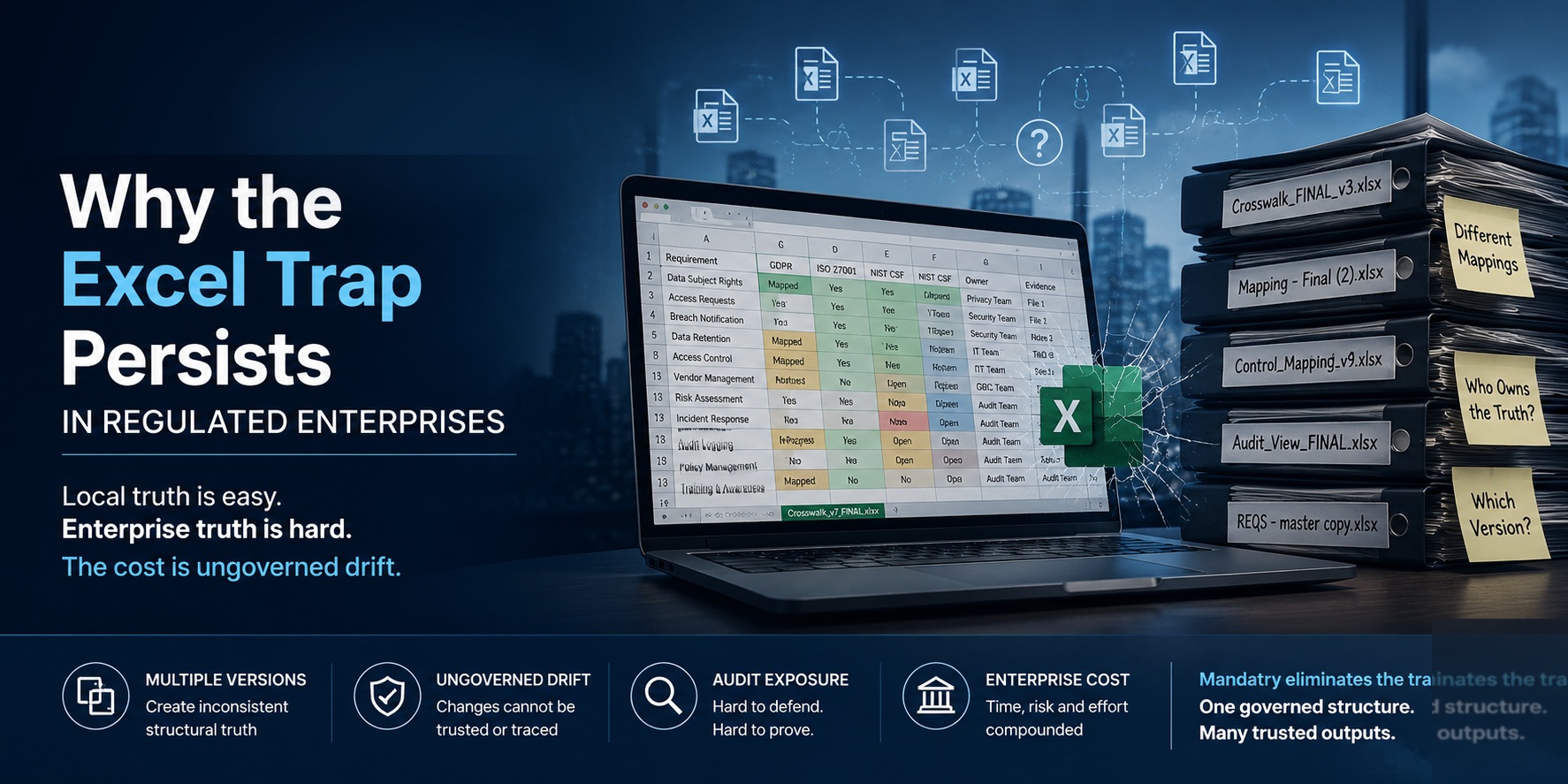
Why the Excel Trap Persists in Regulated Enterprises
Excel persists in compliance because it is the fastest way to create local truth. It also creates ungoverned drift. The real cost is not the spreadsheet itself, but the multiplication of versions, mappings, and interpretations across the enterprise.
Excel persists in compliance for a reason.
It is fast.
When a team needs to compare frameworks, patch a mapping, prepare for an audit, or create a working view of obligations, a spreadsheet is often the quickest way to move from ambiguity to something usable.
That is why the Excel trap is not really about poor behaviour. It is about local optimisation. Spreadsheets are the fastest way to create local truth. They are also one of the fastest ways to create ungoverned drift.
Why Excel survives
Most compliance teams do not choose spreadsheets because they believe spreadsheets are ideal infrastructure.
They choose them because spreadsheets solve immediate problems with very little friction.
They are:
→ flexible
→ portable
→ familiar
→ easy to share
→ fast to modify
That combination is powerful.
A team can build a crosswalk quickly.
An advisor can deliver a mapping in a familiar format.
A control owner can add notes without waiting for a platform change.
A project can move forward even when the underlying system is incomplete.
This is why spreadsheets survive even inside mature enterprises with GRC platforms, monitoring tools, control libraries, and advisory support already in place.
They fill the gap between what the governed system can represent and what a team needs to answer now.
Why that advantage becomes a trap
The same qualities that make spreadsheets useful also make them dangerous as a structural layer.
They are usually:
→ not version-controlled by default
→ non-governed
→ structurally fragile
→ difficult to audit
→ easy to fork
That means a spreadsheet can become authoritative in practice without becoming governable in principle.
A file gets emailed.
A copy is saved locally.
A project team modifies a few rows.
Another function keeps an earlier version because it still supports an active audit.
Soon there is no longer one model.
There are several local models that look similar enough to coexist, and different enough to create inconsistency.
That is the trap.
The real cost is not the spreadsheet
The cost of Excel is not the spreadsheet itself.
The cost is multiplication.
One locally useful file becomes many slightly different structural truths across the organisation.
That is when enterprises start seeing:
→ multiple versions of what is supposed to be the same crosswalk
→ different authoritative mapping views for the same frameworks
→ competing interpretations of the same requirement across teams or projects
→ duplicated evidence requests because obligations have been labelled differently
→ control relationships that cannot be traced back to a stable reference
Each spreadsheet may look harmless on its own.
But the enterprise cost appears when they all survive together.
At that point, the organisation is no longer managing one governed representation of regulatory meaning.
It is managing multiple overlapping approximations.
Why regulated enterprises are especially vulnerable
This problem is sharper in regulated environments because the structural pressure is higher.
There are more frameworks.
More jurisdictions.
More audits.
More external advisors.
More downstream systems consuming compliance logic.
When a new requirement arrives, the fastest response is often to create or extend a spreadsheet.
When a framework changes, the easiest patch is often another spreadsheet tab.
When audit questions arise, the working answer is often a locally maintained evidence or mapping sheet.
That keeps operations moving.
But it also means the enterprise keeps creating structural truth outside the governed system.
The spreadsheet becomes a hidden system of record, even when nobody officially calls it that.
A simple example
Imagine a company tracking overlap between GDPR, ISO 27001, and an internal control framework.
The original mapping lives in one spreadsheet created for an advisory project.
Later, the privacy team updates its version for a new jurisdiction.
The security team reuses the file but changes a few control relationships.
An audit team creates another copy to annotate evidence expectations.
Each version is sensible in context. None is obviously reckless.
But when the business needs to answer a simple question, such as which control satisfies which obligation, the organisation now has multiple answers.
That is not just inconvenience.
It is structural fragmentation.
Why audits expose the problem
Excel works best when truth can remain local. Audits force truth to become shared.
That is why audit pressure exposes spreadsheet dependency so reliably.
An auditor does not only ask to see a document.
They ask which version is authoritative.
They ask why one mapping differs from the version used last quarter.
They ask why the same requirement appears under multiple labels.
They ask how the organisation knows a control relationship is still current.
Spreadsheets struggle here because their flexibility is not matched by structural discipline.
They can be edited quickly.
They are much harder to defend as governed reference systems.
That is why the pain often appears late.
The spreadsheet works until the organisation needs enterprise-wide coherence, lineage, and repeatability.
Why banning spreadsheets is the wrong goal
The right goal is not to ban spreadsheets. That misses the point.
Spreadsheets are useful tools for analysis, working sessions, scenario modelling, and local review.
The problem begins when they become the system of record for regulatory structure.
That is the failure mode to address.
The replacement is not less flexibility.
It is better infrastructure.
What a governed replacement requires
To remove spreadsheets as the regulatory backbone, an organisation needs a structural layer that does what spreadsheets cannot reliably do at scale.
That means:
→ canonical identifiers for obligations and concepts
→ governed mappings rather than ad hoc crosswalk files
→ explicit versioning and lifecycle control
→ reproducible exports for downstream use
→ structural integrity checks that prevent silent drift
→ stable references that can be reused across teams, frameworks, and audits
Once those things exist, spreadsheets can return to what they are good at.
They can support analysis.
They no longer need to hold institutional truth.
Why this changes the economics
A governed structural layer reduces the hidden cost created by spreadsheet multiplication.
It becomes easier to maintain one authoritative mapping view.
It becomes easier to propagate updates without forking local truth.
It becomes easier to defend audit outputs against stable references.
It becomes easier to compare versions without guessing which file was current.
It becomes easier to reduce duplicated interpretation across teams.
That changes the economics of compliance work.
Instead of paying repeatedly for reconciliation between local artefacts, the enterprise can spend more of its effort on analysis, assurance, and decision-making.
What Mandatry changes
Mandatry addresses this by making regulatory structure governable before it fragments into spreadsheet-based local truth.
It focuses on canonical obligations, governed mappings, versioned frameworks, reproducible structural outputs, and production-grade references beneath the compliance stack.
This does not make spreadsheets irrelevant.It makes them non-authoritative.
That is the real shift.
The strategic point
Excel persists because it solves the immediate problem of local truth faster than most systems do.
That is why the trap is persistent. But local truth does not scale.
Once regulatory structure becomes shared across audits, jurisdictions, controls, and enterprise systems, spreadsheets stop being enough.
At that point, the issue is no longer convenience.
It is whether the organisation has a governed reference layer beneath the compliance stack.
When structure becomes reliable, spreadsheets revert to what they should be.
Useful analysis tools. Not the regulatory backbone.
Explore Structural Regulatory Infrastructure
See how Mandatry makes regulatory frameworks structurally comparable through atomic obligations and canonical concepts.